- All of Microsoft
SC-401: Microsoft 365 Retention Hacks
Microsoft MVP | Author | Speaker | YouTuber
Microsoft Purview retention labels and policies, adaptive scopes, policy lookup and eDiscovery for cloud compliance
Key insights
- Retention Policies, Retention Labels, and Microsoft Purview: The video shows how Purview manages the data lifecycle by applying policies and labels to keep or delete content according to rules and compliance needs.
- Creating and configuring policies: You learn step-by-step how to build retention policies, choose locations (Exchange, SharePoint, OneDrive, Teams), set retention periods, and decide whether to retain, delete, or both.
- Retention label publishing and auto-labeling: The guide explains making labels, publishing them to users or containers, and using automatic label assignment to enforce retention with less manual work.
- Adaptive Scopes and dynamic targeting: The presenter uses Adaptive Scopes to target policies based on attributes (groups, users, or metadata), enabling more precise and scalable policy application.
- Policy precedence and Policy Lookup: The video clarifies how conflicting policies resolve, how precedence decides which retention setting applies, and how to use Policy Lookup to verify which rule affects an item.
- eDiscovery, Content Search, and exam-ready tips for SC-401: It demonstrates recovering retained content with Content Search and eDiscovery and encourages hands-on practice with Purview to prepare for the SC-401 exam’s balanced focus on protection, retention, and risk management.
Video Overview and Context
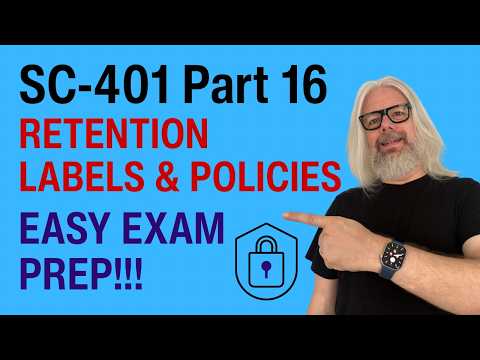
The recent YouTube tutorial by Peter Rising [MVP] serves as Part 16 in his ongoing SC-401 exam preparation series and focuses on practical data retention techniques within Microsoft 365. In straightforward demonstrations, the presenter walks viewers through both policy-based and label-based retention approaches in Microsoft Purview, showing the steps needed to configure and publish retention settings. Consequently, the video targets administrators preparing for the SC-401 certification as well as practitioners implementing governance controls in live environments. Overall, the session balances exam-oriented tips with hands-on configuration examples to help viewers translate theory into practice.
Key Retention Techniques Demonstrated
First, the video explains how to create and configure retention policies that apply broad lifecycle rules across mailboxes and content locations, and then contrasts these with retention labels that offer granular, content-level control. Peter also demonstrates how to publish labels and apply them either manually or automatically, which helps teams enforce retention without relying solely on user actions. Moreover, he highlights Adaptive Scopes as a dynamic way to target specific user groups or workloads, thereby reducing manual maintenance and improving accuracy. Through these demonstrations, viewers see practical ways to combine policies and labels depending on organizational needs.
Interpreting Precedence and Policy Lookup
The tutorial emphasizes how conflicting rules interact and why understanding precedence matters when multiple retention settings apply to the same item. Peter walks through the Policy Lookup concept, showing how administrators can test and verify which retention setting will take effect in a given scenario. As a result, teams can avoid unintended retention gaps or overlaps that might lead to compliance risks. Furthermore, the video recommends routine checks to ensure that intended rules remain active as the environment and user populations change over time.
Recovery, eDiscovery, and Content Search
In addition to setting retention, the presenter covers recovery workflows using eDiscovery and Content Search, explaining how retained content can be located and restored for legal or operational needs. He demonstrates how retention interacts with search and export procedures, which is critical when legal holds or investigations require preserved data. Consequently, the session helps administrators appreciate that retention is not only about deletion control but also about ensuring defensible preservation and retrieval. This perspective aligns retention strategy with practical incident and litigation readiness.
Tradeoffs and Practical Challenges
While the video offers clear steps, it also implicitly highlights tradeoffs administrators face, such as balancing retention duration against storage costs and system complexity. For example, using broad retention policies reduces administrative overhead but can increase retained data volume and cost, whereas fine-grained labels improve precision but require governance and user adoption. Moreover, implementing Adaptive Scopes brings benefits in accuracy but demands robust identity and attribute data, which may be inconsistent in some organizations. Therefore, the choice of approach depends on factors like budget, compliance requirements, and the maturity of identity and content tagging processes.
Exam Tips and Real-World Adoption
Because the SC-401 exam focuses on information protection, data lifecycle, and risk management, the video pairs practical demos with exam-oriented advice to help candidates prioritize likely topics. Peter highlights core capabilities and common pitfalls that exam takers should understand, and he links those practical skills to day-to-day administration tasks. However, viewers should be aware that exam scenarios often assume a clean, well-governed environment, while real deployments may encounter legacy data, mixed workloads, and permission challenges. Thus, hands-on practice alongside lab exercises remains essential to both exam success and real-world readiness.
Implications for Governance and Teams
Finally, the tutorial underscores that retention is a cross-functional effort involving security, compliance, IT operations, and business owners, who must agree on retention requirements and enforcement mechanisms. Effective governance requires clear policies, consistent metadata and attribute management, and regular audits of applied retention rules to prevent drift. In practice, organizations should build feedback loops so that retention rules evolve with regulatory changes and business priorities. By doing so, teams can maintain compliance while managing costs and operational complexity.
Conclusion
In summary, the video by Peter Rising [MVP] offers a concise, practical guide to retention policies and labels in Microsoft Purview, and it frames these features in the context of the SC-401 exam and real-world governance. The demonstrations clarify configuration steps and troubleshooting techniques such as policy precedence and policy lookup, while the discussion around recovery and eDiscovery reinforces the broader purpose of retention. Ultimately, the tutorial helps viewers weigh tradeoffs and plan realistic retention strategies that align with both compliance needs and operational constraints.

Keywords
SC-401 Microsoft 365 data retention, Microsoft 365 retention policies, M365 retention tips and tricks, Retention labels Microsoft Purview, SC-401 exam retention guide, Microsoft 365 eDiscovery retention, Configure retention policies M365, Compliance manager retention Microsoft 365