- All of Microsoft
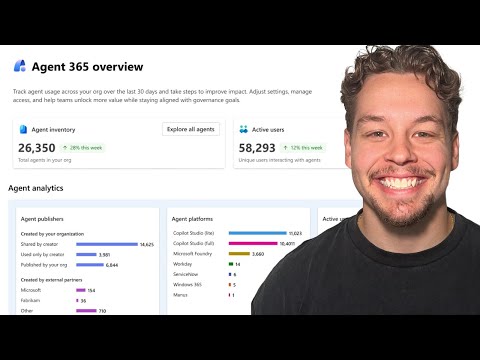
Microsoft Agent 365: Ignite 2025 Reveal
Certified Power Apps Consultant & Host of CitizenDeveloper365
Microsoft expert preview: Agent for AI boosts Copilot governance and observability with Purview, Defender and Entra
Key insights
- Microsoft Agent 365 is a centralized control plane that registers and manages AI agents across an organization.
It gives IT teams a single place to see, control, and audit agent activity. - Registry and observability: Agent 365 maps who created each agent, what tasks it performs, and which data it uses.
This visibility helps find and stop unmanaged or risky "Shadow AI" before it causes problems. - Microsoft Entra issues an Agent ID for each agent so identities and permissions behave like those of human users.
Admins can grant, revoke, or limit data access per agent to reduce exposure. - Microsoft Defender and Microsoft Purview integration provides threat detection, incident response, and data governance for agents.
Together these services enable automated alerts, investigations, and policy enforcement. - Governance and admin controls live in the Microsoft 365 admin center, letting IT scale policy, disable agents, and set monitoring rules.
This makes it practical to manage many employee-built assistants without blocking innovation. - Business impact: Agent 365 reduces adoption risk for tools like Copilot and Power Platform, boosting trust, compliance, and productivity.
It helps organizations use AI safely while keeping data and workflows under control.
Introduction: A First Look at the Video
Griffin Lickfeldt (Citizen Developer) presents an early look at Microsoft Agent 365 in his recent YouTube video, offered as a clear walkthrough of the new platform announced at Ignite 2025. He explains how the service aims to give organizations a control plane to manage AI agents across the workplace, and he places this development in the context of growing enterprise use of Copilot and automated assistants. Moreover, the video frames Agent 365 as a response to rising concerns around unsupervised or "shadow" AI usage inside companies. Consequently, the piece serves as a practical briefing for IT managers, citizen developers, and security teams interested in governance and operational readiness.
Core Features and What the Platform Does
According to the video, Microsoft Agent 365 acts as a centralized registry and management layer for AI agents, tracking who created agents, what they do, and which data they touch. It integrates with tools like Microsoft Purview to map data flows and with Office apps to show agent activity where work happens. Furthermore, Griffin highlights the idea of giving agents a digital identity, referred to as an Agent ID, so they authenticate and authorize like human users. This setup creates a continuous inventory and control surface, which is intended to reduce surprises from unmanaged AI activity.
In addition, the platform ties into existing administration consoles so that IT teams can view and act on agents from the familiar Microsoft 365 admin center. The video also points out connections to productivity layers such as Work IQ, which helps provide context about how agents support day-to-day tasks. Overall, Griffin frames Agent 365 as both a catalog and a control plane that aims to scale governance alongside increasing agent adoption. Thus, the platform seeks to harmonize agent productivity with enterprise policy requirements.
Security and Identity: How Agent 365 Integrates
Griffin emphasizes how Microsoft Defender and Microsoft Entra play key roles in Agent 365’s security story, with Defender offering threat detection and Entra managing agent identities. By assigning each agent an identity, organizations can apply standard identity governance practices and limit what data an agent can access. Moreover, integrating Defender brings threat analytics and automated response capabilities to agent activities, which is important as agents perform tasks that touch sensitive information. Therefore, the combination aims to make agent behavior visible and actionable for security teams.
However, the video also notes that integrating multiple security layers raises operational complexity and requires coordination between identity, security, and data governance teams. Griffin explains that teams must tune policies to avoid too many false positives that could block legitimate agent work. At the same time, without strict controls, agents may expose data or act beyond intended boundaries. Consequently, organizations must balance strong security with operational efficiency to preserve both safety and productivity.
Governance and Observability: Addressing Shadow AI
One of the central themes in the video is how Agent 365 confronts Shadow AI by improving observability and governance across an organization’s agent estate. Griffin describes how the platform surfaces agent lineage, purpose, and data access patterns, helping compliance teams verify that agents meet policy requirements. Furthermore, the Purview integration provides data-classification context, which supports faster risk assessment and remediation. Thus, the platform supplies the audit trails and controls needed to justify AI usage in regulated environments.
Still, the video cautions that observability is only as useful as the policies and processes that act on it, and that organizations should prepare clear workflows for incident handling and policy enforcement. Griffin recommends that firms layer governance with human review points to avoid overreliance on automated rule sets. In effect, Agent 365 promises visibility, but firms must design decision flows and responsibilities to turn that visibility into consistent outcomes.
Tradeoffs and Practical Challenges
Griffin thoughtfully explores the tradeoffs organizations will face when adopting Microsoft Agent 365, noting that centralized control supports security but may slow innovation for teams that rely on quick, low-code agent creation. He explains that while agent identities and strict policies improve accountability, they also introduce administrative overhead that smaller IT teams may struggle to manage. Moreover, integrating multiple platforms increases complexity, and not all organizations have mature governance processes to leverage the platform fully. Therefore, the choice to adopt Agent 365 involves weighing control against speed and simplicity.
In addition, the video highlights practical challenges such as scaling policy enforcement, preventing alert fatigue, and protecting privacy while monitoring agent actions. Griffin suggests phased rollouts and robust change management to reduce friction, and he points out that training citizen developers on guardrails will help balance empowerment with risk reduction. Ultimately, the success of Agent 365 will depend on how well organizations align technology, people, and processes to support a managed agent ecosystem.
What to Watch and Final Takeaways
Griffin concludes by urging viewers to watch how Agent 365 evolves in terms of integrations, usability, and policy automation, since those areas will determine its practical impact on adoption. He stresses that enterprises should pilot the platform with high-value, low-risk scenarios first, and then expand controls as confidence grows. Furthermore, organizations should monitor for administrative complexity and regularly revisit policies to match changing business needs. In short, the video positions Microsoft Agent 365 as a significant step toward controlled AI agent use, while reminding teams that technology alone does not remove the need for thoughtful governance and human judgment.

Keywords
Microsoft Agent 365, Agent 365 Ignite 2025, Microsoft Agent 365 features, How to use Agent 365, Agent 365 vs Copilot, Microsoft Agent 365 release date, Agent 365 pricing and plans, Microsoft AI assistant Agent 365