- All of Microsoft
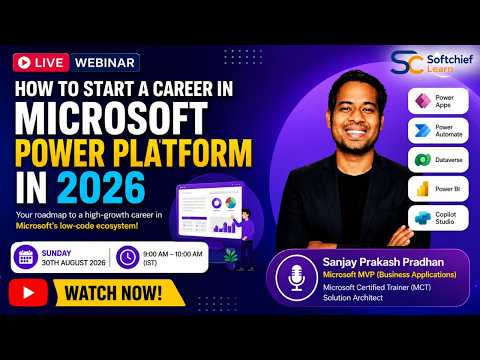
Power Platform Careers: 2026 Guide
Learn how to take advantage of your business data with Microsoft Dynamics 365 & Power Platform & Cross Technologies. My name is Sanjaya Prakash Pradhan and I am a Microsoft Certified Trainer (MCT) and
Microsoft expert guide to launch your Power Platform career with Power Apps Power Automate Power BI and Dataverse skills
Key insights
-
This YouTube video summarizes why building a career in the Microsoft Power Platform is a smart move in 2026.
It guides beginners and professionals on what to learn and how to get job-ready. -
The platform is a low-code ecosystem made of Power Apps, Power Automate, Power BI, Power Pages, Copilot Studio, and Dataverse.
Each tool covers app building, automation, analytics, web pages, AI assistants, and data modeling. -
Power Platform roles remain in-demand across consulting, enterprise IT, healthcare, finance, and government.
The video highlights a fast entry path for beginners and strong salary progression for specialists. -
Core skills to start: learn Power Apps, Power Automate, Power BI, and Dataverse, plus basic integration and data modeling.
Certification notes: PL-900 is the recommended intro; PL-200 retires Aug 31, 2026 and AB-410 is its replacement. -
Hiring priorities in 2026 shift beyond app building toward governance, AI copilots, ALM/DevOps, observability, and fusion team collaboration.
Employers want people who scale, secure, and operate the platform, not just build apps. -
Typical roles include Power Platform Developer, Power BI Developer, Solution Architect, and Governance Specialist.
Practical next steps: build a portfolio of projects, combine platform skills with process knowledge, and focus on governance, security, and AI skills.
Overview
The recent YouTube video from Softchief Learn lays out why building a career in the Microsoft Power Platform remains a strong choice in 2026. The presenter argues that the platform is no longer just about low-code app building; instead, it now blends automation, analytics, data modeling, and AI-assisted experiences. Consequently, employers want people who can combine hands-on platform skills with governance, security, and delivery practices.
Moreover, the video highlights that demand spans freshers, developers, IT staff, and professionals shifting into the Microsoft ecosystem. Therefore, both entry-level and advanced roles are visible across consulting firms, enterprise teams, and partners. As a result, the Power Platform sits at the intersection of business and IT, which creates varied career paths.
Core Technologies to Learn
The speaker recommends mastering several core components, beginning with Power Apps for building forms and business apps, Power Automate for workflows, and Power BI for reporting and visualization. In addition, the video stresses the importance of understanding Dataverse for data modeling and the growing role of Copilot Studio for AI assistants. These building blocks form a coherent stack that organizations use to design end-to-end solutions.
Furthermore, the presenter advises learning integrations with Microsoft 365 and Azure, as well as basic API and connector knowledge. Certifications appear as structured milestones; the video notes PL-900 as the introductory exam and mentions that PL-200 is retiring on August 31, 2026, with AB-410 offered as a replacement for applied skills. Thus, combining credentials with hands-on projects can accelerate hiring prospects.
Career Opportunities and Job Roles
The video outlines a wide range of roles, from junior makers to senior architects, including titles such as Power Platform Developer, Power BI Developer, consultant, and governance specialist. It explains that many organizations hire platform talent for both permanent and contract roles, which widens options for candidates with diverse goals. Also, salary progression can be substantial, particularly for those who add architecture or governance skills.
In addition, the presenter highlights the value of cross-functional work because Power Platform projects often require collaboration with business units. For example, platform specialists can act as bridges between operations and IT, delivering solutions that directly affect process efficiency. Therefore, soft skills and domain knowledge become as valuable as technical ability.
What Changed in 2026 and the Tradeoffs
The video stresses a key shift: the platform has moved from pure low-code to a hybrid model that includes AI, governance, ALM/DevOps, and observability. On one hand, AI copilots and low-code tools speed up delivery and let business users solve problems quickly. On the other hand, this speed introduces tradeoffs, such as increased governance needs and potential security risks if controls are not in place.
Moreover, the presenter points out that prioritizing rapid delivery without structure can create technical debt and operational risk, whereas strict governance slows down innovation. Balancing those competing demands requires people who understand compliance and platform administration as well as app design. Therefore, candidates who can navigate both agility and control will stand out.
How to Start and the Challenges Ahead
To begin, the video recommends a practical roadmap: start with an introductory certification like PL-900, build a portfolio of real projects, and then pursue applied certifications such as AB-410. Furthermore, the creator urges learners to focus on demonstrable outcomes—working automations, dashboards, and data models—because employers look for proof of delivery. Consequently, hands-on practice paired with a few certifications creates a credible profile for recruiters.
However, the presenter also warns about challenges: keeping skills current amid fast platform changes, mastering ALM practices, and addressing security and observability at scale. In addition, integrating AI responsibly adds complexity that requires new governance patterns and testing. Ultimately, the video argues that successful professionals will blend technical depth with operational discipline and continuous learning.
Conclusion
In summary, the Softchief Learn video presents a clear case that the Microsoft Power Platform remains a promising career path in 2026, provided candidates adapt to its expanded demands. Those who balance low-code development skills with governance, security, and ALM knowledge will likely find the most opportunities. Therefore, a measured approach—combining certifications, practical projects, and an understanding of tradeoffs—offers the best route into this evolving field.

Keywords
Microsoft Power Platform career 2026, Power Platform jobs 2026, Power Platform certification guide 2026, How to become a Power Platform developer, Power Platform skills for jobs, Power Apps and Power Automate career, Power Platform consultant salary 2026, Learn Power Platform online 2026