- All of Microsoft
Entra Agent Registry: Corporate AI Index
Product Manager @ Microsoft 👉 Sign up to Entra.News my weekly newsletter on all things Microsoft Entra | Creator of cmd.ms & idPowerToys.com
Microsoft Entra expert: Entra Agent Registry and Agent ID secure AI agents with identity, governance, discovery
Key insights
- Entra Agent Registry and Agent ID form a centralized "corporate yellow pages" for AI agents, giving each autonomous agent a unique identity so organizations can track, authenticate, and authorize agent actions.
They replace ad hoc tracking and bring consistent identity controls across platforms. - Discovery policies help find and register agents automatically, including hidden or shadow agents, and agents can be located by their declared skills to simplify management.
This improves visibility so teams know what agents are active and what they can do. - Agent collections let administrators group related agents for targeted policies and operations, while global collection and quarantine collection settings control which agents are visible or isolated.
Collections make it easier to apply rules and limit exposure quickly. - Custom security attributes automate governance by attaching policy-relevant metadata to agents, and integration with identity protection enables real-time monitoring and anomaly detection.
Automation enforces compliance and reduces manual work at scale. - Collaboration features let agents discover and call other agents by capability, and Agent ID supports secure, auditable interactions as emerging agent standards take shape.
This enables safe multi-agent workflows inside enterprises. - Zero Trust principles and conditional access apply to agents as first-class identities, delivering unified governance, lower operational risk, and better controls for enterprise AI at scale.
These controls help security, identity, and platform teams prepare for widespread agent use.
Introduction
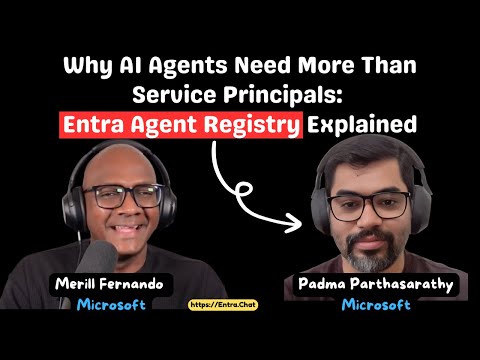
The YouTube episode hosted by Merill Fernando spotlights a Microsoft product designed for enterprise AI governance. In the video, Padma Prasad Parthasarathy explains the motivation and mechanics behind the Entra Agent Registry. He frames the service as a kind of corporate yellow pages where AI agents gain identity and governance. Consequently, the episode aims to help identity and security architects prepare for AI at scale.
Core Components Explained
First, the registry provides a centralized catalog that records autonomous agents and their attributes, and it pairs each agent with a governed identity called Agent ID. This pairing lets organizations authenticate, authorize, and audit agents much like human or service identities. Moreover, the platform supports agent collections and discovery policies that group and surface agents by role or skill. As a result, Teams can apply targeted policies and monitor agent behavior consistently across systems.
How Agent Discovery and Collaboration Work
Agents can announce skills and discover peers through the registry, which makes inter-agent collaboration visible to administrators. Importantly, the registry supports global and quarantine collections that control which agents can be discovered organization-wide and which are restricted for review. Therefore, IT Teams gain the ability to limit exposure while still enabling helpful agent-to-agent workflows. This visibility helps reduce unknown or unmanaged agents that might otherwise create security gaps.
Security Integration and Automation
The episode highlights integration with Microsoft Entra's identity protection and custom security attributes, which automate governance at scale. For example, security attributes let administrators attach compliance or access requirements to agent identities, and then enforce those conditions automatically. Furthermore, anomaly detection and risk scoring can flag suspicious agent actions so teams can act quickly. Consequently, automation reduces manual overhead but requires careful policy tuning to avoid false positives and negatives.
Tradeoffs and Practical Challenges
There are tradeoffs between broad visibility and privacy, and between automated governance and human oversight. On one hand, centralized discovery improves control and helps prevent shadow AI; on the other hand, it increases the amount of telemetry and metadata organizations must store and protect. Similarly, while automation scales policy enforcement, it can misclassify agents when discovery rules or attributes are imprecise, which means security Teams must calibrate thresholds and maintain clear audit trails. Therefore, balancing precision with scale becomes a central operational challenge.
Implications for Enterprise Architects
For identity and security architects, the registry offers a structured way to treat agents as first-class identities under a Zero Trust model. This shift requires updating access models, logging practices, and incident response playbooks so they account for autonomous behavior. Additionally, organizations must decide how to integrate the registry with existing identity providers and whether to onboard third-party agents into the same governance plane. Ultimately, those decisions affect interoperability, administrative overhead, and the speed at which AI capabilities can be adopted safely.
Recommendations and Next Steps
Organizations should begin by mapping current AI agents and establishing discovery policies that minimize disruption while increasing visibility. Next, Teams ought to define security attributes and conditional access rules that reflect risk tolerance and compliance needs. Meanwhile, running pilots with quarantine collections allows Teams to test policies before wider rollout, and iterative tuning helps reduce false alerts. In short, a phased approach balances the need for governance with the operational realities of deploying AI at scale.
Conclusion
The YouTube episode by Merill Fernando featuring Padma Prathasarathy provides a practical look at how Microsoft proposes to manage AI agents through the Entra Agent Registry. While the registry promises better visibility, identity, and automated controls, it also raises clear tradeoffs around data volume, policy precision, and integration effort. Nevertheless, for enterprises preparing for widespread AI use, the registry offers a coherent framework to reduce risk and enforce governance, provided teams plan for careful tuning and ongoing oversight.

Keywords
Entra Agent Registry, Microsoft Entra Agent Registry, corporate AI agents directory, enterprise agent registry, AI agent discovery platform, agent governance for enterprises, Entra agents management, corporate yellow pages for AI agents