- All of Microsoft
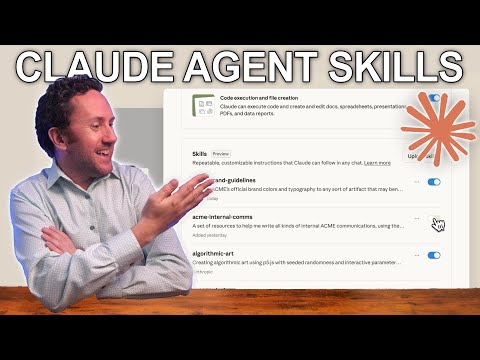
Claude Agent Skills: A New AI Standard
Consultant at Bright Ideas Agency | Digital Transformation | Microsoft 365 | Modern Workplace
Microsoft expert explains Anthropic Claude Agent Skills for AI automation with Copilot, Power Automate and Copilot Studio
Key insights
- Claude Agent Skills are folder-based, modular packages that bundle instructions, templates, and scripts so a Claude model can perform repeatable tasks reliably.
They load only the expertise needed for a task instead of sending all context at once. - Composable, Portable, and Efficient: skills stack together, run across Claude apps and APIs, and load on demand to save time and compute.
This design makes skills easy to reuse and maintain across multiple workflows. - SKILL.md and executable code: each skill includes a guide file, metadata (YAML), resources, and optional scripts that let Claude perform deterministic operations as well as natural language tasks.
That mix improves reliability for precise business steps. - Microsoft 365 integration and Model Context Protocol (MCP): skills can connect with enterprise data and apps via platform connectors and standard protocols, enabling contextual automation inside productivity tools.
They respect organization permissions and governance while accessing files, mail, and calendars. - Progressive disclosure and token-efficient operation: Claude scans available skills and loads only matching instructions, cutting token use and speeding responses.
This reduces context overload and lowers compute cost for complex tasks. - Real-world automations and agent orchestration: skills power tasks like agreement drafting with DOCX tracked changes, spreadsheet generation, and multi-step flows tied into Power Automate or Copilot Studio.
They can change how teams build scalable, domain-specific AI agents for business processes.
Overview of the Video and Its Purpose
In a recent YouTube video, Nick DeCourcy (Bright Ideas Agency) explains a new approach to AI automation called Claude Agent Skills. The video aims to show what these skills are, how they work, and why they could reshape real business processes that use Anthropic’s Claude. Furthermore, the presenter demonstrates step-by-step examples, including a PDF-linked skill and an agreement generation flow that outputs a DOCX with tracked changes. Consequently, the piece positions Claude Agent Skills as a potential new standard alongside ideas like MCP and A2A.
What Claude Agent Skills Are
Claude Agent Skills are modular packages that bundle instructions, templates, scripts, and resources into a folder-based format designed for reuse. For example, a skill might include a SKILL.md guide, YAML metadata, and executable components so the model can run deterministic or semi-deterministic tasks reliably. Moreover, skills load knowledge on demand through a progressive disclosure pattern, which reduces the amount of context the model must hold at once and helps manage token usage. As a result, this design can improve speed and consistency when handling domain-specific tasks.
In addition, skills act like on-demand toolkits for the model: instead of giving the AI a large block of context each time, the agent picks the right skill and loads only what it needs. This makes the approach more token-efficient and more scalable for enterprise scenarios where many distinct workflows exist. However, it also means teams must package and maintain those skills, which adds a development responsibility that not all organizations are ready for. Nevertheless, for repeatable business processes, the payoff can be lower cost and more predictable behavior.
Integration with Microsoft Technologies
The video highlights how Claude Agent Skills can connect to Microsoft services and automation platforms, including integrations with Microsoft 365 Copilot workflows and Power Automate. Specifically, Anthropic’s approach complements open protocols like MCP, enabling context-aware access to content in Outlook, Teams, SharePoint, and OneDrive under enterprise governance. Therefore, organizations that already use Microsoft 365 can potentially embed these skills to create brand-compliant and secure automations inside familiar apps. Furthermore, the presenter demonstrates practical examples where skills generate agreements and manipulate documents programmatically, showing how the model and automation layers work together.
At the same time, integration raises questions about permissions, data residency, and how AI components respect corporate policies. Consequently, IT teams must consider how skills access sensitive data and how they log and audit that access to meet compliance requirements. In short, while the technical fit looks promising, governance and operational controls will determine whether these integrations scale safely in enterprise environments.
Tradeoffs and Technical Challenges
Although Claude Agent Skills offer clear benefits, the approach involves tradeoffs that organizations must weigh carefully. For one, packing executable code into skills improves determinism for some tasks, but that increases the surface area for security vulnerabilities and complicates testing. Moreover, skills require version control, documentation, and automated tests if teams expect them to run reliably at scale.
In addition, building a library of high-quality skills demands skilled staff and a governance model to avoid duplication and drift. For many companies, the choice becomes balancing a short-term push for automation against longer-term investments in developer resources and lifecycle management. Finally, there is a strategic tradeoff between adopting a specific skill format that currently works well with Claude and waiting for broader cross-vendor standards to emerge that might reduce vendor lock-in.
Business Implications and Practical Next Steps
For business leaders, the practical message is that Claude Agent Skills can accelerate automation where repeatable processes exist, such as document generation, contract drafting, and structured data transformation. However, firms should pilot with clear success metrics, start with high-value, low-risk workflows, and apply strict access controls during early deployments. By doing so, teams can learn how skills perform in their environment while limiting potential exposure.
Ultimately, Nick DeCourcy’s video makes a persuasive case that this model of modular, on-demand skills could change how organizations approach AI automation, especially when paired with tools like Microsoft 365 Copilot and low-code platforms. Nevertheless, adopting the approach requires attention to security, governance, and operational maturity, and it favors organizations willing to invest in skill development and lifecycle practices. In conclusion, businesses should monitor developments closely and test selectively to understand whether Claude Agent Skills fit their automation roadmap.

Keywords
Claude Agent skills, Claude AI agents, AI automation standards, Claude agent tutorial, Explaining Claude agent skills, AI agent automation, Claude skill library, Anthropic Claude agents