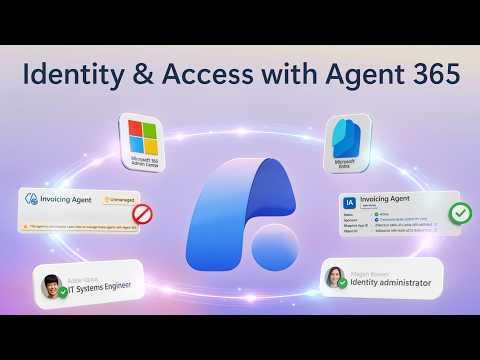
Introduction: Microsoft’s new approach to AI agent governance
Microsoft’s recent YouTube video, presented by Vince Smith from the Entra team, introduces Agent 365 and explains how organizations can treat AI agents as first-class identities. The demo shows how to discover agents across multiple clouds and assign dedicated identities without rebuilding existing identity systems. Consequently, IT and security teams can apply familiar controls to nonhuman actors while keeping audit trails of agent activity.
Moreover, the video frames this work as an extension of Microsoft Entra’s capabilities, with a focus on bringing Conditional Access, lifecycle policies, and monitoring to agents. Importantly, Microsoft positions this as a way to separate managed agents from unmanaged ones and to reduce the operational risk of unchecked AI activity. As a result, organizations get a centralized view that aims to simplify governance across AWS Bedrock, Google Vertex, Databricks, Salesforce, and Microsoft services.
How Agent 365 and Entra Agent ID work together
At the core of the solution is Agent 365 as a unified registry and the underlying Entra Agent ID identity fabric that assigns each agent a dedicated identity. The video demonstrates discovery and registration workflows and shows how administrators can assign an agent identity via a command-line tool or SDK. Consequently, policies and access controls can target agents directly the same way they target users or applications.
Furthermore, the model relies on telemetry and sign-in correlation to make agent activity auditable, and it integrates with existing Entra features so teams do not need to recreate their identity stack. This lets organizations apply consistent rules across humans and agents while preserving existing investments. Thus, the approach supports gradual adoption rather than forcing disruptive platform changes.
Visibility and controls: what the platform enables
The demo emphasizes visibility at scale: administrators can surface agents running in multiple ecosystems into a single registry, and then apply controls such as Agent Blueprints and Conditional Access. With these tools, teams can enforce least privilege, require specific authentication factors, or block risky sign-ins for particular agent identities. As a result, organizations can reduce lateral risk when agents access sensitive resources.
Additionally, Microsoft shows how sign-in logs capture authentication attempts, policy hits, and failures for agents, creating an audit trail suitable for security review and incident response. This telemetry supports automated detection and manual investigation, and it ties agent activity back to enterprise compliance efforts. Therefore, the platform helps security operations teams understand both routine and anomalous agent behavior.
Tradeoffs and operational challenges
While Agent 365 promises stronger control, the video also implies tradeoffs organizations must weigh. For instance, strict access policies reduce risk but can interrupt agent workflows or slow innovation; conversely, permissive settings preserve agility but raise the chance of credential misuse. Therefore, teams will need to balance protection with productivity by choosing appropriate policy granularity and enforcement windows.
Moreover, there are practical challenges in discovery and integration: finding agents across multiple clouds and third-party platforms can produce false positives or miss shadow agents entirely, and joining those agents into a centralized registry requires coordination with development and platform teams. In addition, scaling policy enforcement and dealing with noisy telemetry can create alert fatigue unless detection rules are tuned carefully. Thus, success depends on cross-team processes and ongoing governance, not only on technology.
Limitations, licensing, and recommended next steps
The video makes clear that the current model focuses on agent identity and access rather than every credential downstream of an agent, and that some capabilities require specific Entra licensing tiers and Agent 365 entitlements. Consequently, organizations should map capabilities against their compliance needs and budget constraints before full adoption. In practice, teams must plan for license costs, integration effort, and pilot phases to verify controls work as intended.
Finally, Microsoft’s guidance in the demo suggests starting with discovery, then applying blueprints and least-privilege policies to high-risk agents before broad rollout. Organizations should build feedback loops between security, identity, and developer teams so policy exceptions and agent lifecycle events are handled smoothly. By combining technology, processes, and measured rollout, teams can gain the visibility and governance the video promises while managing the tradeoffs inherent in agent-first identity controls.