- All of Microsoft
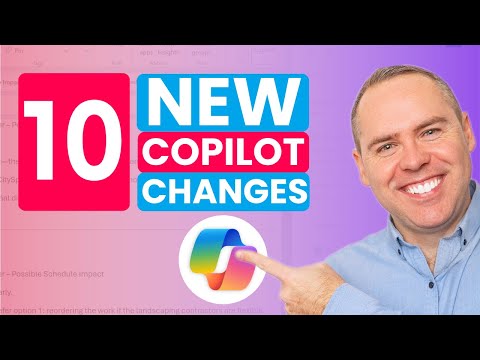
Microsoft 365 Copilot: 10 New Features
Helping you and your company achieve more in Microsoft 365
Microsoft Copilot pro tip brings Chat across Office with Claude AI, Excel app skills and Teamflect to boost productivity
Key insights
-
Copilot Chat in Word, PowerPoint, Excel and Outlook appears as a sidebar you can use to draft, summarize, and update content without leaving the app.
You can expand chats into full conversations and the improved chat history helps you revisit past context quickly. -
Excel App Skills speed up data work with natural‑language queries, smarter formulas, and automated insights.
Use them to clean data, create charts, and get analysis suggestions faster. -
The Researcher in Word finds credible sources, creates summaries, and cites content for you.
Built‑in Document Insights surface key facts, action items, and concise overviews to save reading time. -
Temporary Chat gives you quick, throwaway conversations for fast ideas or tasks without cluttering your main history.
Support for intelligent agents and employee self‑service agents automates HR and IT requests and routine workflows. -
New image, audio and video capabilities let Copilot reason about, edit, and generate visuals; create videos; and produce transcripts.
Copilot can also make audio overviews of documents so you can listen to summaries on the go. -
Admin management tools in the Microsoft 365 admin center let IT pin agents tenant‑wide, monitor adoption, and apply governance settings.
Mobile enhancements add agent access and flexible billing so teams can use Copilot securely from any device.
Overview: A concise walkthrough of the video
Scott Brant’s recent YouTube video walks viewers through a set of recent updates to Microsoft 365 Copilot, highlighting practical changes that affect everyday workflows. In particular, he demonstrates a mix of chat-driven helpers, multimodal features, and admin controls that appear across Word, PowerPoint, Excel, and Outlook. Moreover, the video compares new conversational tools with existing workflows to show how AI now plugs more directly into common tasks.
Importantly, the presentation aims to be hands-on rather than promotional, with examples of drafting, summarizing, and generating content inside native apps. Brant also points out integrations with third-party agents and model upgrades to contextualize the improvements. Ultimately, the clip reads as a practical tutorial for users and administrators assessing whether to adopt these features now.
Key features demonstrated in the video
First, the presenter focuses on the expanded Copilot Chat experiences embedded in Word, PowerPoint, Excel, and Outlook, showing how users can keep an interactive assistant visible while working. Then he demonstrates new Excel “App Skills” that aim to accelerate data analysis by interpreting spreadsheets and suggesting formulas or visualizations. Additionally, the video covers unfolding conversation threads and temporary chats that help maintain context while experimenting with ideas.
Next, the author highlights capabilities like audio summaries of documents and improved slide editing with AI suggestions, which together support both content creation and content consumption. He also outlines multimodal features such as image editing and generation inside chat, and updates to transcript and video creation tools. Finally, Brant notes integration with models like GPT-5 and the option to use other models such as Claude AI within research workflows, indicating broader model choice for users.
Practical implications and tradeoffs
On one hand, these updates promise productivity gains because AI can summarize long threads, draft responses, and transform notes into slides more quickly than manual methods. Consequently, teams may complete routine tasks faster and spend more time on high-value work. On the other hand, relying on AI-generated content introduces tradeoffs: users must verify accuracy and guard against hallucinations, and organizations must balance convenience with oversight.
Moreover, mobile and pay-as-you-go models expand access but raise cost-management questions for enterprises. Therefore, while the new features lower the barrier for experimentation, decision-makers must weigh adoption speed against licensing costs and user training needs. In short, the benefits are clear, yet they require intentional governance and realistic expectations.
Challenges: governance, accuracy, and integration
Brant’s video acknowledges several challenges that accompany deeper AI integration. For instance, administrators need better controls to pin agents tenant-wide, monitor usage, and enforce compliance, which can become complicated in large organizations that host sensitive data. Consequently, IT teams face a delicate balance between enabling helpful AI features and maintaining rigorous data protection standards.
Similarly, the video raises issues around model grounding and source citation when Copilot references documents or web content; in practice, organizations must configure knowledge sources and review outputs to reduce misinformation. Finally, multimodal features such as image generation and audio summaries introduce operational complexity, because they expand the attack surface for errors and require updated policies for acceptable use. Therefore, careful rollout strategies and training are essential to manage the risks.
What administrators and users should consider
Administrators should evaluate the new admin tools and usage reports mentioned in the video to decide how to pilot features and measure adoption. In addition, teams should create simple guidelines about when to trust AI outputs and when to require human review, thereby preserving quality without becoming a bottleneck. Furthermore, organizations might pilot specific agents for HR or IT tasks to validate value before broader deployment.
From the user perspective, the video demonstrates that small, repeated savings—like faster email triage or automated slide updates—can accumulate into significant productivity gains. However, users also need basic literacy about AI limitations so they can validate facts and refine prompts effectively. Thus, investment in short training sessions and clear templates can smooth the transition and reduce frustration.
Conclusion: measured adoption and next steps
Overall, Scott Brant’s walkthrough provides a thoughtful snapshot of how Microsoft 365 Copilot is evolving, with practical demonstrations that help teams assess the changes. While the new features offer clear efficiency gains, the video also underscores that governance, training, and cost management are central to successful adoption. Therefore, organizations should proceed with pilots, monitor outcomes, and adapt policies as the technology matures.
In conclusion, the updates shown in the video are worth testing for teams that regularly create documents, analyze data, or prepare presentations. Yet, as Brant emphasizes, a cautious, measured approach that balances agility with control will produce better long-term results than a rushed, ungoverned rollout.

Keywords
Microsoft 365 Copilot new features, Copilot features 2025, Microsoft Copilot tips and tricks, Copilot productivity features, Microsoft 365 AI updates, Copilot integration Teams Outlook, Copilot security and compliance, How to use Microsoft Copilot