- All of Microsoft
- Microsoft 365
First Fridays: Frontier Newsletter Tips
Software Development Redmond, Washington
Microsoft expert shares Frontier mindset, unlearning employee communications and AI driven work with Copilot and Teams
Key insights
- First Fridays is a Microsoft series for corporate communicators that explains how AI changes work and engagement.
It focuses on the November session called Frontier Communicator, which helps communicators lead AI adoption and shape employee experience. - The core idea is the Frontier Firm, an organization that embeds AI agents as digital colleagues to scale faster and act more agile.
These agents work alongside people to speed up decisions and automate complex tasks. - Key tools include Microsoft 365 Copilot for research and analysis, Security Copilot for threat response, and Copilot Studio to build custom agents.
These tools synthesize data, create visuals, and run repeatable workflows with human oversight. - Major benefits are enhanced productivity and automation of routine work, letting staff focus on higher-value tasks.
The model also creates new roles like agent bosses, who manage and guide AI agents. - Governance matters: the Copilot Control System and clear policies help IT securely deploy agents across teams.
Organizations often use a phased AI integration approach, moving from assistants to agent-driven workflows under human supervision. - For communicators, the session stresses building trust, guiding cultural change, and redesigning messages for AI-enabled work.
Communicators must help leaders and employees understand benefits, risks, and new collaboration patterns.
Overview of the Video
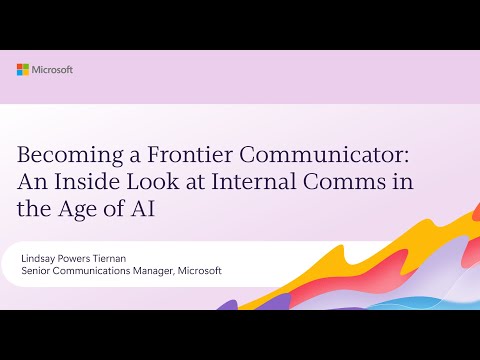
The Microsoft video titled First Fridays November - Becoming a Frontier Communicator features Lindsay Powers Tiernan, Senior Communications Manager at Microsoft, discussing how communicators can adapt as organizations adopt AI agents. The session is part of a recurring series aimed at helping corporate communicators understand practical AI adoption and leadership roles in the workplace. Consequently, the video frames communicators as central to shaping culture, trust, and the employee experience as companies transition to AI-augmented work.
Moreover, the presentation introduces the concept of the Frontier Firm, an organizational model in which AI agents operate alongside people to scale operations and speed decision-making. The video highlights real-world examples such as Microsoft 365 Copilot and Security Copilot, while also showing how teams build custom agents with tools like Copilot Studio. As a result, the material aims to help communicators move from awareness to actionable practices for guiding this change.
What "Frontier Communicator" Means
First, the video defines a Frontier Communicator as someone who helps their organization unlearn legacy assumptions about internal communications and adopt new patterns that include AI agents. In addition, the role involves translating technical change into human-centered narratives that sustain trust and clarity across teams. Therefore, communicators must balance technical accuracy with approachable explanations so employees accept and effectively use AI tools.
Furthermore, the session emphasizes new responsibilities like training leaders to act as agent supervisors and designing employee experiences that integrate AI routines safely. Communicators must also monitor sentiment and adjust messaging as systems evolve, which requires continuous feedback loops. Consequently, the role becomes part strategist, part translator, and part steward of workplace culture.
Tools and Practices Highlighted
The video showcases several Microsoft technologies intended to operationalize AI across business functions, including Microsoft 365 Copilot for productivity workflows and Security Copilot for cybersecurity tasks. It also mentions governance features such as the Copilot Control System, which helps IT manage agent deployment and permissions. These tools demonstrate how organizations can deploy domain-specific agents that reason about particular tasks rather than relying on generic assistance.
In practice, presenters recommend starting with focused use cases that deliver clear value and build trust, such as automating routine reports or triaging security alerts. They also suggest using pilot programs to collect evidence and refine approaches before scaling. As a result, communicators can show tangible benefits to stakeholders while maintaining transparency about limits and oversight.
Tradeoffs and Challenges
While AI agents can accelerate productivity and free employees for higher-value work, the video candidly discusses tradeoffs such as potential errors, privacy concerns, and uneven access across teams. For example, automating decision support can increase speed but may also amplify mistakes if models hallucinate or misinterpret context. Therefore, communicators must frame benefits alongside clear guardrails and explain how governance, testing, and human oversight reduce risk.
Moreover, the session explores cultural challenges like fear of job displacement and resistance to change; communicators need to manage these anxieties by highlighting new roles and re-skilling opportunities. There is also tension between centralized governance and local innovation: strict control can protect data and compliance, yet overly rigid rules may stifle useful experimentation. Consequently, organizations must balance safety with agility and communicate that balance effectively.
Practical Advice and Next Steps
The video closes with practical steps for communicators who want to lead their organizations toward a frontier approach: start small, measure outcomes, and iterate on messaging based on employee feedback. It recommends partnering with IT and business leaders to design pilot programs that demonstrate value while testing governance models. Additionally, communicators should document successes and failures transparently to build organizational learning and credibility.
Finally, the session urges communicators to become fluent in the capabilities and limits of AI agents so they can design policies that protect people and data while enabling useful automation. By doing so, communicators will help their employers evolve into organizations where AI acts as a reliable teammate rather than an unpredictable tool. In short, the video frames communication as a strategic lever for safe, equitable, and effective AI adoption.
https://hubsite365cdn001img.azureedge.net/SiteAssets/TopicImages/marvin-meyer-SYTO3xs06fU-unsplash.jpgKeywords
First Fridays November, Becoming a Frontier Communicator, Frontier communicator workshop, First Fridays communication event, Public speaking and communication skills, Frontier communication strategies, Networking for communicators, Professional communicator training