- All of Microsoft
Microsoft Fabric: Exclusive Insights & FabCon 2025 Uupdates
Founder | CEO @ RADACAD | Coach | Power BI Consultant | Author | Speaker | Regional Director | MVP
Power BI Mobile Office Integration Teams PowerPoint Outlook FabCon 2025 Updates Microsoft Fabric upcoming features
Key insights
- Microsoft Fabric is an integrated platform that brings together data engineering, data science, and business intelligence, making it easier for teams to manage data workflows and collaborate from data ingestion to visualization.
- The product team, including Maya Shenhav (Power BI) and Miguel Llopis (Data Integration), highlighted new Power BI enhancements, especially improved mobile support and deeper integration with Office apps like Excel, Teams, PowerPoint, and Outlook.
- Data integration capabilities in Fabric have advanced, allowing users to create and manage data pipelines more efficiently. This supports a wide range of data sources and formats, helping organizations accelerate their analytics processes.
- The interviews emphasized the value of a unified platform approach. By combining Power BI with other analytics tools in one system, Microsoft Fabric reduces complexity and enables faster insights for both business users and technical teams.
- FabCon 2025 updates include stronger mobile features, better Office integration within Power BI, and improvements to streamline data pipelines—all designed to make analytics more accessible and user-friendly.
- Main advantages of Microsoft Fabric are its streamlined workflows across different data roles, broad accessibility through mobile and Office apps, and simplified operations by reducing the need for multiple specialized tools.
Introduction: Key Insights from the Microsoft Fabric Team at FabCon 2025
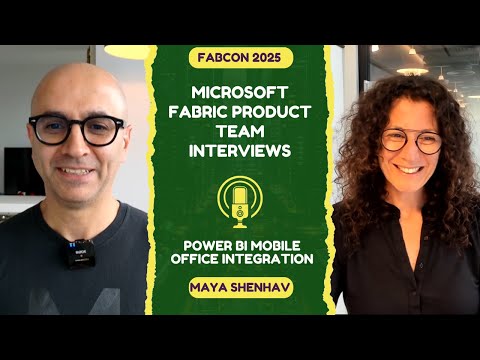
A recent interview conducted by Reza Rad (RADACAD) [MVP] with Maya Shenhav, Principal Product Manager on the Power BI team, offers a detailed look at the latest updates in Microsoft Fabric. This conversation, recorded around the time of the highly anticipated FabCon 2025 conference, highlights significant advancements in Power BI Mobile and Office Integration, as well as future plans for the platform. The discussion underscores Microsoft’s commitment to creating a unified and user-friendly analytics ecosystem.
Microsoft Fabric: An Integrated Analytics Platform
At its core, Microsoft Fabric is designed as an all-in-one platform to simplify data engineering, data science, and business intelligence tasks. By bringing together various tools and services, Microsoft aims to streamline complex data workflows and foster greater collaboration among teams. This unified approach is especially significant for organizations seeking to reduce the operational burden of managing multiple, disconnected analytics tools.
With Fabric, users can move seamlessly from data ingestion and preparation to analytics and visualization. This integration not only accelerates time-to-insight but also encourages smoother teamwork between business and technical users. As a result, companies can make more informed decisions with less friction.
Power BI Mobile and Office Integration: Expanding Accessibility
A major focus of the interview was the ongoing enhancements to Power BI, particularly its mobile support and deeper integration with Microsoft Office products like Teams, PowerPoint, and Outlook. According to Maya Shenhav, these updates are designed to empower users to access and interact with data insights wherever they are, using the devices and applications they rely on every day.
This strategy not only broadens accessibility but also embeds analytics into daily business processes. For example, team members can pull up dashboards within Outlook or present live reports directly in PowerPoint, streamlining how insights are shared and acted upon. However, achieving this level of integration requires careful planning to balance feature richness with performance and usability, especially on mobile platforms.
Enhancing Data Integration: Meeting Diverse Needs
The discussion also covered advances in Fabric’s data integration capabilities. The product team has prioritized simplifying data ingestion and preparation, making it easier for organizations to connect with a wide range of data sources and formats. These enhancements help users build and manage data pipelines more efficiently, supporting faster analytics workflows.
Nevertheless, integrating diverse data sources presents challenges, such as ensuring data consistency and managing security. The team’s approach focuses on reducing complexity without sacrificing flexibility, allowing both technical professionals and business users to benefit from streamlined operations.
Unified Platform and Its Tradeoffs
The unified platform approach adopted by Microsoft Fabric offers clear benefits, such as lowering costs and reducing operational complexity by minimizing reliance on multiple specialized tools. This holistic strategy fosters collaboration and accelerates insight generation across different roles within an organization.
However, balancing the needs of varied user groups—ranging from data engineers to business analysts—can be challenging. The team must ensure that advanced features do not overwhelm less technical users, while still providing the depth required by power users. Striking this balance is crucial for maintaining both usability and robust functionality.
Looking Ahead: Roadmap and Innovation
FabCon 2025 served as a pivotal moment for announcing these updates and sharing the vision for Microsoft Fabric’s future. The roadmap includes continued innovation in mobile and Office integrations, as well as further enhancements to data integration capabilities. The product team remains focused on simplifying the data lifecycle—from ingestion to visualization—while keeping the user experience at the center of development efforts.
As Microsoft Fabric evolves, organizations can expect a more accessible, comprehensive, and user-driven analytics platform. This direction holds promise for those looking to modernize their analytics infrastructure and empower decision-makers at every level.
Keywords
Microsoft Fabric interview Maya Shenhav Reza FabCon 2025 updates Microsoft Fabric product team FabCon 2025 highlights SEO keywords for Microsoft Fabric