Copilot Cowork: Collaborate with AI
Software Development Redmond, Washington
Copilot Cowork: delegate tasks to AI with MS three sixty five and Power Platform, automate reports, stay in control
Key insights
- Copilot Cowork: an agentic assistant that plans and runs multi-step tasks for you. It executes work across apps, pauses for approvals, and returns ready-to-review results like decks or reports.
- Work IQ: the context engine that pulls data from your emails, meetings, files, and business systems. It grounds plans in your real Microsoft 365 content so outputs stay relevant and accurate.
- Finished artifact: Cowork delivers completed outputs instead of drafts, saving time on editing and assembly. Examples include presentation decks, briefing documents, and scheduled meetings saved back to M365.
- Built-in skills: integrated capabilities span Word, Excel, PowerPoint, Email, Scheduling, Meetings, Search, Research, PDF, and Adaptive Cards. Cowork composes the right skills automatically to meet your requested outcome.
- Agentic framework: Cowork runs in the cloud inside your Microsoft 365 tenant and uses advanced reasoning models. You can add custom skills (for tailored automation) and use partner plugins to extend functionality.
- Copilot Credits & security: usage-based billing charges for jobs you run, keeping costs predictable. All prompts, responses, and artifacts flow through existing Microsoft 365 controls for governance, compliance, and data protection.
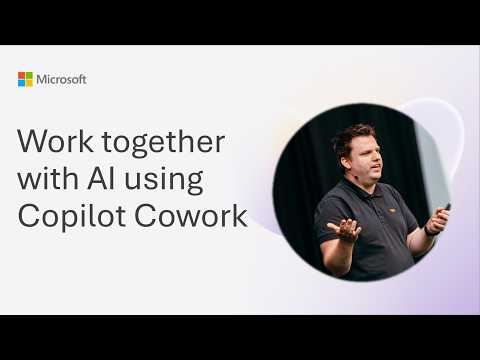
Microsoft released a demo video that showcases Copilot Cowork, a new approach to delegating real work to AI within the Microsoft 365 ecosystem. In the clip, presenter Daniel Laskewitz walks viewers through how the tool plans and runs multi-step tasks, pulls context from calendar and email, and produces finished artifacts like reports and decks. Consequently, the video frames Copilot Cowork as more than a chat helper: it is an agentic assistant designed to carry out end-to-end tasks while keeping the user in control. As a result, organizations can consider shifting routine coordination and assembly work to an automated partner that still pauses for human approvals.
What the Video Demonstrated
The demo opens by showing how Copilot Cowork accepts a desired outcome and then breaks it into discrete steps that use tools across Microsoft 365. For example, the assistant collects emails and files, synthesizes meeting packets, and generates a final presentation saved directly to the tenant. Moreover, the video highlights built-in skills for common apps including Excel, PowerPoint, and Word, which the agent selects automatically based on the task. The presenter also pauses at key decision points to emphasize that the user remains responsible for approvals and quality checks.
How Copilot Cowork Works
Behind the scenes, the system relies on a multi-model design that matches model capability to task need, which helps balance performance and cost. In addition, the agent pulls context from your tenant through a context engine called Work IQ, so actions reflect relevant emails, meetings, and files rather than generic web data. The demo also shows that teams can add up to 50 custom skills by placing SKILL.md files in a dedicated OneDrive folder, allowing organizations to tailor automation to their processes. Furthermore, the video notes that some reasoning tasks draw on partner models such as Claude developed with Anthropic, while routine steps can use smaller, cheaper models.
Security, Governance and Costs
The video stresses that every prompt, response, and generated artifact stays within the organization's existing Microsoft 365 controls to preserve governance, discovery, and retention policies. Consequently, enterprises gain the familiar benefits of tenant-level protection rather than relying on local agent tools that may expose data. On the cost side, the demo explains a usage-based pricing model measured in Copilot Credits, which means teams pay for the jobs they run instead of for a blanket subscription. However, this approach also requires teams to monitor consumption to avoid unexpected costs when automating many tasks at scale.
Customization and Extensibility
Copilot Cowork supports custom skills and partner plugins to extend capability beyond built-in actions, and the demo highlights examples of both. Organizations can create tailored automations by authoring skill definitions and hosting them in OneDrive, which encourages reuse across departments. At the same time, adding custom skills introduces overhead: teams must manage versioning, test behavior, and ensure consistent security handling. Thus, while extensibility offers strong benefits, it also demands governance and development effort to keep automations reliable and compliant.
Tradeoffs and Practical Challenges
The video candidly acknowledges tradeoffs that organizations will face when adopting agentic automation. For instance, delegating more work to an automated agent can save time, yet it raises questions about trust, accuracy, and the need for human oversight, so teams must strike a balance between convenience and control. Additionally, switching between efficient and frontier models helps contain costs, but it introduces complexity in monitoring which model runs which job and when higher-cost reasoning is justified. Finally, integrating partner plugins and custom skills boosts capability, yet it increases the surface area for potential failures and requires tighter change management to avoid process drift.
Outlook for Teams and Users
Overall, the video positions Copilot Cowork as a practical step toward broader AI-assisted work within enterprises, combining automation with familiar governance and a pay-per-job cost model. For teams that spend much time coordinating content and schedules, the tool promises real efficiency gains, while still leaving critical decisions in human hands. Nevertheless, organizations should plan for governance, cost oversight, and a gradual rollout to build user trust and to refine custom skills. In the end, the demo suggests that careful adoption can help organizations get the most value from agentic tools while managing risks and costs.

Keywords
Copilot Cowork collaboration, collaborate with AI Copilot, AI coworking tools, Copilot for teamwork, Copilot Cowork productivity, Microsoft Copilot collaboration, Copilot Cowork tips, AI-assisted team collaboration