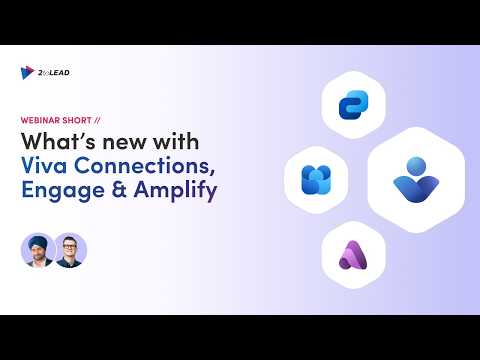
Viva Connections: Engage & Amplify
Viva Connections Engage Amplify news on SharePoint Copilot AI agents shaping Microsoft three sixty five workplace
Key insights
- Video source and focus
Short clip from an M365Conf 2026 recap webinar summarizing updates to Viva Connections, Viva Engage, and Viva Amplify.
It highlights how Microsoft is shaping internal communications across M365. - Core roles of each app
Viva Connections serves as the branded employee entry point for news and resources.
Viva Engage drives community conversation and leadership communication.
Viva Amplify manages campaign planning, publishing, and measurement. - Key new direction
Microsoft focuses on an integrated communications model with cross-app publishing so teams create once and distribute across Teams, Outlook, SharePoint, and Viva.
They emphasize more targeted announcements and branded employee experiences. - Notable feature updates
Engage adds tools for leadership posts, articles, and Storylines to support deeper conversations.
Connections expands dashboard cards and tailored experiences for different groups.
Amplify improves scheduling, approvals, localization, and analytics for campaigns. - Main benefits
Teams get multi-channel publishing and a single place for campaign management, which reduces duplicated work.
Improved targeted messaging and built-in analytics help measure impact and refine outreach. - Practical next steps
Map use cases: decide which app handles entry, communities, and campaigns.
Start a small pilot using Amplify, set governance, and align with your intranet strategy for clear results.
Overview of the Video
The short YouTube clip from 2toLead summarizes recent product updates for Viva Connections, Viva Engage, and Viva Amplify and frames them as a connected employee communications stack. In addition, the clip is a condensed excerpt from a longer webinar titled M365Conf 2026 Recap, which focused on SharePoint, Copilot, and AI agents for the digital workplace. Consequently, the video aims to show how these three Viva apps work together to centralize news, communities, and campaign management for internal communicators.
What’s New and Why It Matters
First, the clip highlights an integrated communications model where content creators can publish once and distribute across Teams, Outlook, SharePoint, Viva Engage, and Viva Connections. Moreover, Viva Connections now emphasizes branded employee entry points with targeted announcements, dashboard cards, and tailored experiences for different groups. As a result, organizations can present a consistent front door to employees while delivering messages that matter to local teams.
How the Three Apps Fit Together
According to the presenter, Viva Amplify functions as the campaign hub where communicators draft, schedule, and measure messaging, while Viva Engage serves as the conversational and leadership layer that supports long-form posts and community dialogue. Meanwhile, Viva Connections is positioned as the branded home where those campaigns and conversations reach employees in context. Therefore, the combination aims to reduce duplicated effort and keep campaigns coordinated across multiple Microsoft 365 channels.
Advantages Highlighted in the Clip
The video stresses several practical benefits, including centralized campaign management, multi-channel publishing, and improved targeting for localized audiences. In addition, analytics built into Amplify promise measurable engagement so communicators can see which channels and messages perform best. Consequently, teams that already use Microsoft 365 may find it easier to reach employees in familiar tools while maintaining consistent governance and branding.
Tradeoffs to Consider
However, the clip also implies tradeoffs that organizations must weigh, starting with the complexity of managing cross-app workflows versus the efficiency gains from centralization. For example, while a single campaign hub reduces repeated work, it requires clear processes, governance, and role definitions to avoid bottlenecks in approvals and localization. Additionally, branding and targeted experiences add value, but they also demand more design and content resources to maintain separate, meaningful experiences for different employee groups.
Technical and Organizational Challenges
Beyond tradeoffs, the presenter touches on implementation challenges that span both technology and people. Integration across SharePoint, Teams, and Viva tools may require updates to governance policies, security settings, and content lifecycle practices, so IT must work closely with communications teams. Moreover, smaller teams may struggle to staff campaign planning, approvals, and analytics, which means organizations should consider phased rollouts and training to spread the workload effectively.
User Experience and Targeting
The clip emphasizes targeted announcements and tailored dashboards to improve relevance, arguing that relevancy increases engagement. Yet, delivering tailored experiences depends on accurate audience segments, profile data, and consistent taxonomy, which can be difficult to maintain in large or highly distributed organizations. Consequently, teams must balance precision in targeting with the operational cost of keeping audience data and content variants up to date.
Governance, Measurement, and Change Management
Furthermore, the video suggests that governance and measurement are central to realizing value from these tools, because analytics inform what works and where to focus effort. However, collecting useful analytics requires a clear measurement plan and patience to iterate, especially when trying new formats like leadership Storylines or localized campaigns. Therefore, communicators should pair technical dashboards with regular reviews and qualitative feedback to refine strategy over time.
Practical Recommendations
For teams evaluating these updates, the clip recommends treating Viva as a system rather than three separate apps and starting with clear use cases such as executive communications or major campaigns. In addition, it advises building simple governance and pilot programs to test cross-app workflows before scaling. Finally, investing in training for both creators and approvers can shorten the learning curve and help realize the efficiency gains the video describes.
Final Thoughts for Decision Makers
In sum, the 2toLead clip provides a concise overview of how Viva Connections, Viva Engage, and Viva Amplify are evolving toward a unified internal communications stack. While the integrated model promises clearer reach and reduced duplication, it also introduces governance, resourcing, and data challenges that organizations must manage actively. Ultimately, the short video serves as a practical prompt for communicators and IT leaders to align on use cases, governance, and measurement before broader rollouts.
Keywords
Viva Connections update, Viva Engage features, Viva Amplify update, Microsoft Viva news, Viva Connections 2026, Viva Engage best practices, Viva Amplify tutorial, Viva employee experience