Microsoft Copilot: Will It Replace Jobs?
Microsoft 365 Expert, Author, YouTuber, Speaker & Senior Technology Instructor (MCT)
Microsoft expert on AI robots reshaping jobs and homes, workforce impact and Microsoft Teams helpdesk Tikit by Cireson
Key insights
- Physical robots: Companies such as Tesla and Figure aim to bring AI-powered robots to industrial and home markets around 2026.
These robots combine advanced AI with mobility and manipulation, changing how manufacturing, logistics, and some home tasks are done. - AI augmentation: Microsoft’s real-world deployments (notably Bing Copilot) show AI helps people do information, writing, and analysis work faster and more accurately.
Data from user interactions in 2024 indicate AI often augments human work rather than fully replacing it. - Large language models (LLMs): LLMs drive code generation, content creation, chatbots, and data reporting in workplace tools.
They excel at pattern-based tasks but fall short on physical work, emotional judgment, and some complex problem solving. - Upskilling: Many companies focus on retraining employees to use AI tools, shifting staff into higher-value roles instead of only cutting jobs.
Microsoft notes a large share of code now comes from AI, which has pushed investments in training and changing job responsibilities. - Limitations: AI and robots still struggle with hands-on dexterity, human interaction, and unpredictable real-world tasks.
Jobs that require physical skills, empathy, or complex on-site decisions remain comparatively safer from automation. - Job market shift: Economists and experts disagree on the speed and scale of displacement, but most agree planning is essential—policy, training, and transition support are needed.
Organizations should balance productivity gains with programs that protect and reskill workers for new roles.
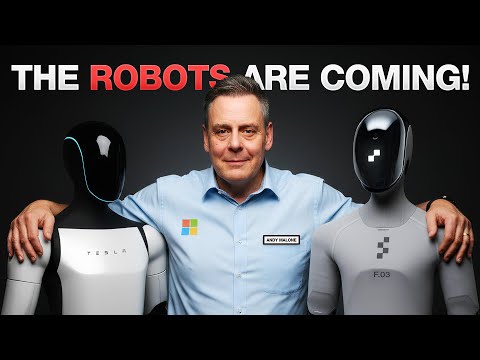
In a recent YouTube video, tech commentator Andy Malone [MVP] frames the arrival of advanced AI-driven robots as a major turning point for work and daily life. He highlights that companies such as Tesla and Figure are preparing robot products for a broader market launch in 2026, and he asks a central question: will these machines take our jobs? Consequently, the video mixes optimism about new capabilities with concern for worker displacement and calls for practical discussion about how society should respond.
What the Video Presents
First, the video explains the current state of robotics and AI, showing how software advances have started to match improvements in hardware. Andy Malone emphasizes that the next wave involves physical robots paired with generative AI systems, which could perform tasks beyond simple automation. Moreover, he contrasts these developments with existing AI tools that mainly assist knowledge work, rather than doing hands-on labor.
Second, the video frames these robots as both industrial and domestic solutions, suggesting they could move from factories into homes and warehouses. Malone points out that the technology promises higher productivity and new services, while also raising questions about safety, reliability, and long-term cost. Therefore, viewers are urged to weigh both the immediate benefits and the hidden costs when evaluating adoption.
How the Technology Works
Malone explains the difference between large language models and embodied robots, noting that the former excel at processing information while the latter add physical capability. He highlights that systems like Bing Copilot and other generative tools help with writing, coding, and decision support, yet they still rely on human judgment for many complex tasks. Meanwhile, physical robots bring additional engineering challenges, including perception, manipulation, and safety in human environments.
In addition, the video stresses that integration matters: software must be tuned to hardware, and workflows need redesign to benefit from automation. Malone notes that successful deployments often pair AI assistants with human operators, which enhances productivity without immediate replacement. Consequently, the partnership model appears more common in real deployments than full substitution.
Potential Impacts on Jobs
Malone balances his coverage by discussing both job risks and opportunities, and he cites examples of companies using AI to change roles rather than cut them entirely. For instance, he references industry cases where employees are upskilled to manage AI tools and oversee robot fleets, which creates new responsibilities and career paths. However, he also acknowledges that routine and physically repetitive roles face higher short-term risk of automation.
Furthermore, the video explores the tradeoffs firms must weigh between efficiency and social responsibility. Firms that push rapid automation may gain cost advantages, yet they also face public scrutiny and potential retention problems among skilled staff. Thus, Malone urges companies to invest in reskilling programs and to plan transitions that protect workers while enabling innovation.
Challenges and Risks
Malone identifies several practical challenges, including safety certification, robust perception in messy environments, and the ethical use of AI in decision-making. He warns that early robot deployments could fail when engineers underestimate real-world complexity, which could harm public trust. Moreover, the video highlights regulatory gaps that governments will need to close to ensure safe, fair adoption.
At the same time, Malone points to social and economic risks like increased inequality if access to new roles and training remains uneven. He suggests that policymakers and businesses must collaborate to create frameworks for liability, workforce transition, and continuous education. In short, solving technical problems alone will not suffice; society must address structural issues as well.
Outlook and Practical Steps
Finally, Malone offers a measured outlook that combines urgency with caution, and he encourages a pragmatic mix of planning and experimentation. He recommends that companies pilot robot deployments in controlled settings, measure real productivity gains, and create clear retraining pathways for affected employees. Additionally, he argues for transparency around performance expectations so stakeholders can judge tradeoffs fairly.
Ultimately, the video frames the arrival of advanced robots as an opportunity to redesign work rather than simply eliminate jobs. Nevertheless, Malone makes it clear that realizing benefits will require careful coordination among developers, employers, workers, and regulators. Therefore, the coming years will test how well society balances innovation, safety, and fairness as these new machines enter the workforce.

Keywords
robots taking jobs, robots replacing jobs, AI automation and jobs, automation job loss, future of work automation, AI job displacement, robotic process automation jobs, robots in the workplace