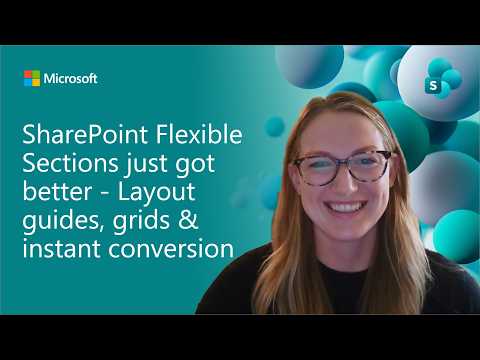
Overview of the Video
The YouTube demo, produced by Microsoft, showcases recent additions to SharePoint's page authoring tools, focusing on the evolution of Flexible Sections. The video hosts walk through new editing controls and conversion tools, and they demonstrate practical scenarios that authors face when modernizing pages. Presenters explain features step by step so viewers can see how the changes behave in real pages and in email previews.
Overall, the clip aims to help site authors spend less time rebuilding layouts and more time creating content. Consequently, the narrative emphasizes both speed and structure, showing how editors can keep creative freedom while adding predictable alignment aids. The demo also invites user feedback, noting that input will influence the product roadmap.
What’s New in Flexible Sections
First, the video introduces Flexible layout guides, which act like visual column references that authors can enable while editing. Second, a persistent Guides and Grid toggle lets designers keep alignment aids visible or hide them and remembers that preference for future sessions. Third, a one-click converter — described in the demo as the flexible transformer — can instantly convert to flexible section from classic three-column sections without losing web part placement.
In addition, the demo shows that web parts dragged from the toolbox auto-size to the chosen guide while still allowing full manual resizing, overlapping, or repositioning. Importantly, the hosts demonstrate how the layout guides remain effective in an email preview, preventing awkward stacking when a page is repurposed as an email. These refinements aim to make flexible, freeform layouts feel more structured and predictable for both desktop and email contexts.
How Authors Will Benefit
The changes promise to speed up common tasks because authors no longer need to rebuild page layouts from scratch when moving from classic sections to flexible ones. With visible guides and a remembered grid preference, editors gain consistency across sessions, and the demo highlights fewer alignment errors. As a result, teams can produce cleaner pages faster while preserving their design intent.
Moreover, the one-click conversion addresses a core pain point: migrating older content without manual repositioning. The hosts show that web parts, spacing, and guide structures survive the conversion, which reduces risk and lowers the effort required for modernizing intranets. Thus, organizations can adopt modern layouts incrementally rather than committing to large-scale rewrites.
Tradeoffs and Practical Challenges
Nevertheless, the new flexibility introduces tradeoffs between creative freedom and consistent design governance. While authors gain a 2D canvas for precise placement, this freedom can lead to divergent visual styles across pages if governance and templates do not guide usage. Therefore, organizations will need to balance empowerment with clear design rules and training to avoid inconsistent experiences.
Another challenge is the learning curve that comes with added controls: authors must learn when to rely on guides and when to override them. The demo shows helpful defaults, but power users may still create complex overlapping arrangements that behave unpredictably on small screens or in email clients. Consequently, testing policies and rendering checks remain essential for organizations that send pages as email previews or publish to diverse devices.
Adoption Outlook and Next Steps
The video frames these updates as part of an ongoing rollout that began when Flexible Sections reached broad availability, and the presenters encourage feedback to shape future work. For teams planning adoption, the safest path is to pilot the new features on a few pages, validate email previews, and document best practices for authors. In this way, groups can measure benefits without exposing large numbers of pages to untested layouts.
In closing, the demo from Microsoft presents practical refinements that help authors build cleaner pages faster while keeping the option to customize freely. Equally important, the video makes clear that successful adoption depends on governance, testing, and user training to manage tradeoffs between flexibility and consistency. Viewers who manage SharePoint sites should watch the demo, try the controls in a test tenant, and provide feedback through the video comments or the SharePoint blog to help shape future updates.