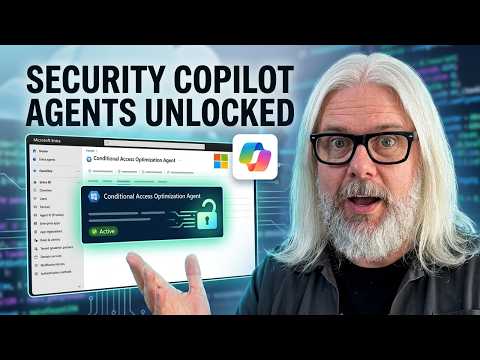
Security Copilot: Agents Remake Defense
Microsoft MVP | Author | Speaker | YouTuber
Microsoft Entras Security Copilot Agents automate Conditional Access and identity risk to boost Azure security
Key insights
- Security Copilot Agents: Generative AI agents inside Microsoft Security Copilot that automate routine security work, correlate signals across tools, and help teams shift from reactive incident handling to proactive defense.
- Conditional Access Optimization Agent and Identity Risk Management Agent: New Entra admin center agents that tune access policies and prioritize risky identities, offering clear remediation steps while keeping humans in control.
- Autonomous workflows with human-in-the-loop: Agents pair large language models with security telemetry to run actions, generate queries (NL2KQL), and learn from feedback so teams keep oversight and policy alignment.
- Operational efficiency and faster response: Agents cut time spent on repetitive tasks, reduce investigation time from hours to minutes, and let analysts focus on complex threats—some customers report up to ~50% faster responses.
- Integration and customization: Teams can create no-code custom agents and deploy them via the Security Store; agents use existing security compute and connect across Defender, Sentinel, Entra, Intune, Purview, and other Microsoft services.
- Zero Trust and improved visibility: Agents enhance end-to-end visibility across identity, endpoints, cloud, data, and networks, and operate within governance controls to ensure actions meet organizational security policies.
Overview: A New Chapter for Enterprise Security
In a recent YouTube video, author Peter Rising [MVP] demonstrates how Microsoft 365’s latest innovations are arriving in everyday security operations. Specifically, he guides viewers through the new Security Copilot Agents inside the Entra admin center and explains how these agents use generative AI to automate routine tasks. As a result, organizations may see faster triage and clearer remediation guidance, while teams can focus on higher-value investigations.
Moreover, Rising emphasizes that these agents do not replace human judgment but augment it, operating under human oversight and feedback loops. He highlights two early examples — the Conditional Access Optimization Agent and the Identity Risk Management Agent — which aim to tighten identity controls and reduce administrative load. Consequently, the presentation frames agents as tools to scale defenses rather than as one-size-fits-all solutions.
Live Walkthrough in the Entra Admin Center
Rising takes viewers step by step through the Entra admin center to show how agents are configured and how they present recommendations. First, he demonstrates how an analyst can ask an agent to evaluate risky sign-ins or suggest changes to conditional access policies, and then how the agent generates prioritized actions and code snippets in natural language. This approach lowers the technical barrier, allowing staff who are less familiar with query languages to get targeted responses quickly.
Furthermore, the video shows how agents pull signals from across Microsoft 365’s security stack to present a unified view, including integrations that surface context from tools like Defender, Sentinel, and Microsoft Purview. Rising notes that agents generate KQL queries and remediation steps, which can be reviewed and adapted by analysts before execution. Thus, the demo demonstrates practical value while also reinforcing the importance of human review.
Key Agents and What They Do
Rising explains several agent types and their roles, starting with the Conditional Access Optimization Agent, which recommends policy tweaks to reduce risk without disrupting users. He then covers the Identity Risk Management Agent, which prioritizes risky accounts and suggests investigations or mitigations based on observed behaviors. In addition, he references broader capabilities such as the Threat Intelligence Briefing Agent and the Vulnerability Remediation Agent, which can summarize threats and suggest fixes across endpoints and cloud services.
Importantly, Rising points out that these agents use existing compute and licensing constructs like SCUs and slot into a marketplace experience called the Security Store. Moreover, administrators can create or customize agents with no-code tools to fit local workflows and compliance needs. Therefore, organizations can adapt agents to different maturity levels while keeping oversight and policy control intact.
Tradeoffs: Speed, Accuracy, and Control
While the video highlights clear productivity gains, Rising is careful to discuss tradeoffs. For instance, automated recommendations can speed response times, yet misapplied changes could create gaps if they are accepted without sufficient review. Consequently, the balance between speed and governance becomes a central theme, and Rising advocates for staged rollouts and testing in non-production environments.
Additionally, the reliance on aggregated signals raises questions about data scope and context; agents that perform well in one environment may need tuning elsewhere. Therefore, organizations must weigh the benefits of automation against the need for local calibration and human validation. In short, the promise of reduced manual work comes with the responsibility to monitor agent behavior and outcomes closely.
Challenges and Practical Considerations
Rising also outlines common implementation challenges that IT teams should anticipate, such as change management, skill gaps, and policy alignment. He suggests that teams invest in training and establish clear feedback loops so agents learn from human decisions and become more accurate over time. Moreover, he recommends aligning agent outputs with existing incident response playbooks to avoid confusion during critical events.
Finally, the presenter notes privacy and compliance considerations, encouraging organizations to map agent actions to regulatory requirements and to limit automation scope where needed. As these agents become more capable, maintaining a clear audit trail and retaining human signoff on high-risk changes will help mitigate operational and legal risks. Overall, Rising’s video frames agents as powerful helpers that require careful governance to deliver sustained value.

Keywords
Security Copilot, Copilot security agents, enterprise defense automation, AI security agents, Microsoft Security Copilot, SOC automation, threat detection AI, autonomous threat hunting