Project Solara: Microsoft AI Devices
Content Creator & former Microsoft Product Manager
Microsoft expert preview: Project Solara unveils wearable AI badge and desktop AI companion powering AI agents
Key insights
- Project Solara introduces a new class of agent-first devices, shown as a portable wearable badge and a stationary desktop companion.
These concepts aim to let AI run continuous, task-focused agents instead of traditional apps. - The platform uses a chip-to-cloud design with deep Azure integration and reportedly runs on Android foundations.
Microsoft is working with chip partners like Qualcomm and MediaTek to build reference hardware. - Microsoft frames a move from app-centric computing to agent-centric computing, where devices surface the right agent automatically.
Agents can act across voice, vision, touch and other multimodal inputs to finish tasks more naturally. - The platform targets business use with enterprise controls such as Intune, Entra ID, and Windows Hello for Business for security and device management.
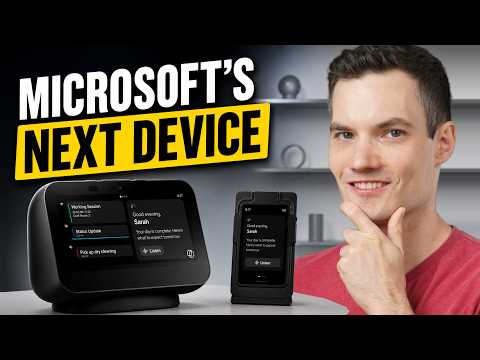
It can link to cloud desktops like Windows 365 for richer workplace scenarios. - Prototype hardware highlights: the badge offers a touchscreen, camera, microphones, speaker and fingerprint reader; the desktop prototype adds a screen, speakers, mics and facial recognition.
Devices can record, transcribe, wake agents by tap or voice, and coordinate multiple agents for different tasks. - Important caveat: these are platform previews and concept prototypes, not consumer products.
Microsoft expects third-party hardware partners to build industry-focused devices for industry verticals like healthcare, retail and finance as the platform matures.
Overview: Kevin Stratvert’s First Look at Microsoft’s New Concept
In a recent YouTube video, host Kevin Stratvert visited Microsoft’s Redmond campus to preview a platform Microsoft calls Project Solara. The video offers an exclusive, hands-on look at concept hardware and the company’s vision for devices built around conversational AI agents rather than traditional applications. As a result, the footage sheds light on both the technology and the strategic direction Microsoft is testing, while noting that these items remain prototypes rather than retail products.
Moreover, the demonstration frames the initiative as an enterprise-first effort, emphasizing manageability and security for business customers. Kevin explains how Microsoft imagines AI becoming more ambient in daily workflows, delivered through small, dedicated devices instead of relying solely on smartphones and PCs. Consequently, the presentation invites careful consideration of how form factor, cloud dependency, and identity controls will shape future deployments.
The Devices: Wearable Badge and Desktop Companion
The video highlights two prototype concepts: a portable, sensor-rich wearable and a stationary desktop hub. The wearable, described as a wearable badge, integrates a camera, microphone array, touchscreen and fingerprint reader so it can capture and transcribe conversations, offer contextual suggestions, and respond to visual prompts; meanwhile, the desktop option acts as a dedicated AI presence with a display, speakers, microphones and facial recognition to enable quick interactions.
Importantly, Kevin shows how Microsoft envisions these devices as task-specific interfaces rather than miniaturized PCs, and the demos suggest a focus on short, frequent interactions. However, that choice brings tradeoffs: while dedicated hardware can be optimized for responsiveness and local sensors, it also raises questions about battery life, hardware cost, and the complexity of managing multiple devices per user. Therefore, enterprises will need to weigh those tradeoffs against potential gains in productivity and natural interactions.
Technical Foundation and Partner Model
According to the demonstration, Project Solara is a chip-to-cloud system that pairs on-device capabilities with Azure-powered intelligence in the cloud. Rather than running full traditional apps, devices would host and coordinate lightweight AI agents that rely on cloud models for deeper processing. Kevin notes that Microsoft is using an Android-based foundation for the concept and that early chip partners include Qualcomm and MediaTek, while Azure handles the heavy lifting for agent tasks.
Furthermore, Microsoft plans not to sell the hardware directly; instead, the company expects partners to build devices from reference designs for industry-specific deployments. This approach reduces Microsoft’s manufacturing risk and encourages vertical specialization, yet it introduces coordination challenges for consistent security, software updates, and user experience across different vendors. As a result, enterprises may gain choice but also shoulder more integration work.
Use Cases, Tradeoffs and Enterprise Focus
Kevin’s video highlights target verticals such as healthcare, retail and financial services where continuous, hands-free intelligence could add clear value. For example, a wearable could record consultations for later documentation, while a desktop companion might streamline check-in workflows or surface contextual knowledge in customer service interactions. In those scenarios, the benefits include faster access to insights and reduced reliance on switching apps, which can save time and reduce cognitive load.
Nevertheless, this model forces tradeoffs around privacy, control, and offline capability. Continuous sensing and transcription are powerful, but they require robust identity and access management—features Microsoft ties to tools such as Intune, Entra ID, and Windows Hello for Business—to meet enterprise security standards. At the same time, heavy dependence on cloud connectivity and vendor ecosystems may limit performance in low-bandwidth settings, so organizations must balance immediacy with resilience.
Challenges Ahead and Market Outlook
Kevin stresses that these prototypes illustrate a direction rather than a final product, and Microsoft itself frames the initiative as a platform preview. Key challenges include ensuring reliable multimodal interactions, securing sensitive audio and visual data, and delivering consistent agent behavior across contexts. Moreover, convincing organizations to adopt new device classes will require clear ROI and simplified management to offset the cost of deploying another hardware layer.
In conclusion, Kevin Stratvert’s coverage of Microsoft’s Project Solara captures a thoughtful experiment in reimagining how people access AI: through purpose-built, agent-first hardware. While the concept promises more natural and immediate interactions, it also raises important tradeoffs in privacy, infrastructure dependency, and partner-driven device consistency. Therefore, the platform’s ultimate success will depend on how Microsoft and its partners address those technical and operational challenges as they move from preview to practical deployments.
Keywords
Microsoft Project Solara, Project Solara devices, Microsoft AI devices, Windows AI devices, Surface AI PCs, AI-enabled PCs, Microsoft AI hardware, Enterprise AI edge devices