Microsoft Copilot for Enterprises: Guide
Content Creator & former Microsoft Product Manager
Microsoft Copilot decode licensing, master Copilot Chat and prompts, use Copilot in Microsoft three sixty five apps
Key insights
- Video summary: This is a concise newsroom summary of a YouTube tutorial that explains Microsoft Copilot for organizations, hosted on a tech channel.
It walks viewers through how to check your subscription and what Copilot features you may already have. - Licensing and access: Verify whether your Microsoft 365 Business or Enterprise plan includes built-in Copilot features or requires the full Copilot add-on.
Know that some capabilities appear in base subscriptions while advanced features need an upgrade. - Core integration: Copilot works inside familiar apps—Copilot Chat, Word, Excel, PowerPoint, Outlook and Teams—so users get assistance without leaving their workflows.
Expect drafting help, formula generation, meeting summaries, and slide creation directly in those apps. - Security and context: Copilot grounds answers in your organization’s data and follows tenant-level controls, encryption, and compliance policies.
The platform’s Work IQ model aims to use context from emails, calendars, and docs while keeping data protected. - Customization and agents: Use Copilot Studio to build and publish tailored agents that connect to Planner, Outlook, Teams and other systems.
This lets teams automate specific workflows and scale Copilot capabilities across the organization. - Best practices: Improve results with clear prompts using the GCSE framework (Goal, Context, Specificity, Example) and always apply fact-checking to AI outputs.
Also organize work with Pages and Notebooks, schedule prompts, and roll out Copilot gradually to test security and adoption.
Overview: A Practical Guide to Microsoft 365 Copilot
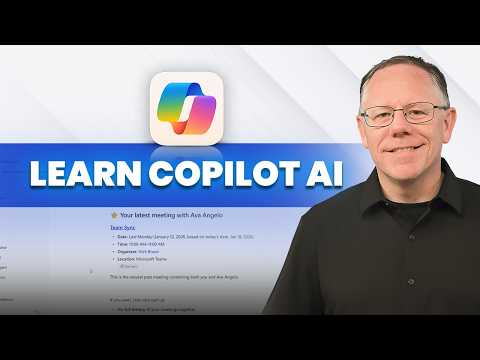
Kevin Stratvert's recent YouTube tutorial offers a clear, step-by-step introduction to Microsoft 365 Copilot aimed at organizational users. The video aims to clarify licensing, distinguish built-in features from the paid add-on, and show practical use inside familiar apps like Word, Excel, PowerPoint, Outlook, and Teams. Additionally, Nick Brazzi hosts portions of the walkthrough, guiding viewers through demonstrations and real-world examples to make the concepts easier to follow.
Overall, the presentation balances high-level context with hands-on tips, so IT leaders and everyday users can both gain value. Consequently, viewers can leave the video with a better sense of whether their subscription already includes useful Copilot features or if they need to upgrade. This approach makes the tutorial useful for teams planning pilots or wider rollouts.
What the Video Covers
The tutorial begins with practical steps to identify which Copilot capabilities are available under an organization’s current Microsoft 365 subscription. Then it dives into how to use Copilot Chat, how Copilot accesses secure work data, and how to analyze documents and source material to support decisions. The video further demonstrates content creation, such as drafting documents and generating images, and shows collaborative features like Pages and Notebooks.
Kevin also covers more advanced topics including scheduling prompts, writing better prompts, and using Copilot-specific functions inside key applications. For example, he demonstrates how Copilot can draft emails in Outlook, create formulas in Excel, and accelerate presentation design in PowerPoint. These practical demos aim to reduce the learning curve for users and help IT teams plan training and governance efforts.
How Copilot Works in an Organizational Context
The video explains that Copilot grounds its responses in an organization’s own data—emails, documents, calendar items, and Teams conversations—so outputs stay relevant to workplace context. Moreover, Kevin highlights that enterprise-grade deployments emphasize tenant-bound data storage and encryption, which helps maintain compliance and security controls. The presenter refers to the concept of Work IQ to describe how Copilot understands context across workflows rather than treating queries as isolated prompts.
In addition, the tutorial touches on customization through tools like Copilot Studio, which lets organizations build tailored agents tied to business systems and workflows. This customization can make Copilot more valuable because agents can automate specific tasks and connect to internal services. However, Kevin also notes that customization increases the need for governance to ensure agents behave predictably and respect access rules.
Benefits and Tradeoffs
Kevin outlines clear productivity benefits, such as faster drafting, automated meeting summaries, and simplified data analysis, which can reduce routine work and let employees focus on higher-value tasks. At the same time, the video emphasizes tradeoffs: granting broad access to data improves Copilot’s usefulness, yet it raises concerns about scope of access, data governance, and regulatory compliance. Therefore, organizations must carefully balance the value of comprehensive context with privacy and security controls.
Another tradeoff discussed is between out-of-the-box convenience and deeper customization. While built-in Copilot features require less setup and lower immediate cost, customized agents deliver better alignment to specific business processes but demand more time, technical skills, and governance oversight. Consequently, decision-makers should weigh short-term productivity gains against long-term maintenance and oversight responsibilities.
Finally, Kevin addresses risks around reliability and accuracy. AI-generated outputs can accelerate work, yet they also require human review to prevent errors or misinterpretation. Thus, organizations should adopt verification practices and training so users know when to trust Copilot and when to validate its suggestions.
Implementation Challenges and Practical Recommendations
The tutorial highlights common hurdles such as licensing confusion, varied feature sets across subscription tiers, and the need for prompt engineering skills among staff. For example, many teams may have limited access initially and will need to decide whether to upgrade or to pilot features within a smaller group. Kevin recommends clear pilot plans that involve security, legal, and HR teams to evaluate the tool before broader deployment.
He also recommends practical steps like training users on prompt best practices—referencing a simple framework for clear goals and context—and establishing review workflows so AI outputs undergo appropriate checks. Moreover, monitoring and measurement are important; teams should track time saved, error rates, and adoption metrics to assess return on investment. These steps help balance rapid adoption with responsible usage.
In conclusion, the video offers a measured and actionable roadmap for organizations considering or already using Microsoft 365 Copilot. With clear demonstrations and governance advice, Kevin Stratvert helps organizations weigh productivity gains against security, cost, and oversight needs, and he provides pragmatic recommendations to guide pilots and scaled deployments.

Keywords
Microsoft Copilot for Organizations tutorial, Microsoft Copilot deployment guide, Copilot for Microsoft 365 admin setup, Copilot security and compliance for enterprise, Copilot licensing and pricing for organizations, Copilot integration with Teams and SharePoint, Copilot training and best practices, Copilot admin configuration step-by-step