Microsoft 365: Maturity Benchmarks 2026
Software Development Redmond, Washington
Microsoft expert recap Frontier Firm Maturity Model for Microsoft three sixty five boosts skills with Teams SharePoint
Key insights
- Maturity Model for Microsoft 365: A practical framework of business competencies that maps Microsoft 365 capabilities to real-world business activities. The May 19, 2026 community recording frames the model as a set of tools to measure and improve organizational maturity.
- Five-point scale (100–500): The model uses clear maturity levels from foundational to advanced to describe what organizations can do at each stage and what they should invest in next.
- Frontier Firm perspective: Links the model to the AI-era operating model where work shifts to human-agent workflows, with people acting as "agent bosses" who orchestrate outcomes by delegating tasks to AI.
- Core competency areas: Key focus zones include Business Process, AI & Cognitive Business, Collaboration, Governance, Employee Experience, and Content & Search. These guide assessments and improvement plans.
- Practical priorities for leaders: Assess where AI changes work, strengthen governance and security for agent-based work, and use maturity assessments to plan repeatable, AI-enabled operating patterns.
- Next steps and community: The public call recording (May 19, 2026) emphasizes using the model as actionable tools and invites Microsoft 365 teams to join community calls and contribute to ongoing updates.
Summary of the Video Recording
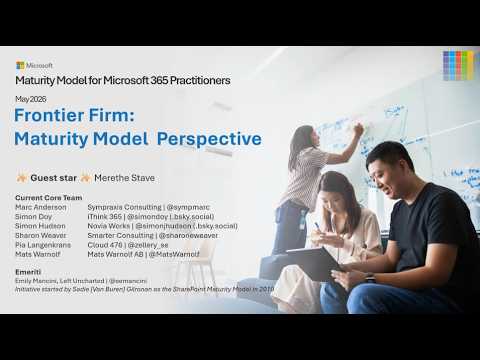
The May 19, 2026 recording titled Maturity Model for Microsoft 365 presents a community briefing from Microsoft that frames the maturity model as practical guidance for organizations using Microsoft 365. The session, which the company published as a YouTube video, emphasizes that the model measures real business activities rather than product checklists. Furthermore, the presenters position the model as a set of tools designed to help organizations assess and raise their maturity across defined competency areas. As a result, viewers are encouraged to treat the model as actionable guidance rather than pure theory.
Introducing the Frontier Firm Perspective
In addition, the recording introduces a new lens called the Frontier Firm, which ties into a broader 2026 operating model focused on the AI era. The presenters explain that the Frontier Firm concept maps maturity to how organizations redesign work, moving from simple AI assistance to human-led agent workflows. Moreover, they describe progression stages—such as foundation, AI adopter, and AI mature—that reflect increasing reliance on automated agents and orchestration by people. Consequently, the video stresses that this evolution is about matching work models to desired outcomes rather than adopting AI everywhere indiscriminately.
Core Competencies at the Model’s Heart
The recording reinforces that the model organizes assessment around a set of core competencies aligned to business needs, not just platform features. These include areas such as process, collaboration, AI and cognitive business, governance, people and training, and content management, which together form the rubric for measuring maturity. The presenters clarify that each competency is assessed on a five-point scale from 100 to 500, with descriptions that help teams identify current state and next steps. Thus, the model aims to translate abstract goals into concrete capabilities that leaders can plan against.
How the Model Is Intended to Be Used
Moreover, the video repeatedly frames the maturity model as a toolkit that supports change: artifacts, assessment guides, and community calls aim to make adoption practical. The hosts explain that practitioners should use the model to prioritize investments, plan training, and align governance to enable AI-driven workflows. They also encourage participation in community calls and contributions to artifacts so that the model evolves with real-world experience. Therefore, the emphasis is on iterative improvement and shared learning rather than fixed certification.
Tradeoffs Between Speed and Control
However, the recording is frank about tradeoffs organizations face when moving toward Frontier Firm behaviors, especially between rapid innovation and measured control. On one hand, adopting agent-based workflows can accelerate outcomes and unlock new productivity, but on the other hand, it raises governance, security, and compliance concerns that require upfront work. The presenters recommend balancing quick pilots with robust guardrails so that experiments scale safely, which means investing in policy, monitoring, and role design. In short, the promise of faster results must be weighed against the risk of misaligned processes and regulatory exposure.
Challenges in Measurement and Organizational Change
In addition, the video highlights challenges in assessing maturity that go beyond technical metrics, such as cultural readiness and workflow redesign capacity. Measuring human-agent orchestration requires new indicators—like agent reliability, human oversight quality, and cross-team coordination—that many organizations have not tracked before. The presenters note that transforming operating models is often slower than technology adoption, which means leaders must plan for sustained change management, not one-off projects. Consequently, organizations should expect a multi-year journey that balances capability building with demonstrated value.
Practical Recommendations for Leaders
For Microsoft 365 and IT leaders, the recording offers practical next steps: first, map where AI and automation already affect work and identify high-value targets for safe scaling. Second, strengthen governance and compliance to allow agent workflows to expand without introducing unacceptable risk, including role definitions and monitoring. Third, use maturity assessment tools to sequence investments and training so that people and systems develop together. Together, these actions create a clearer path from experimentation to repeatable, enterprise-safe patterns.
Community and Ongoing Work
Finally, the presenters emphasize community engagement as a core part of the initiative, inviting practitioners to contribute artifacts and share lessons from real deployments. They describe the model as living guidance that will shift with new patterns and practical insight, which is why community calls and shared documentation are important. Consequently, organizations that participate can both learn from peers and influence the evolution of the model. Thus, the maturity model stands as a collaborative effort intended to keep pace with rapid platform and workplace change.
Conclusion
Overall, the YouTube recording gives a pragmatic overview of how the Maturity Model for Microsoft 365 applies to organizations preparing for the AI era and why the Frontier Firm perspective matters. It stresses that maturity means more than technology adoption: it requires governance, training, workflow redesign, and clear measurement to balance speed with safety. While the path to higher maturity involves difficult tradeoffs and sustained effort, the model offers a structured approach that leaders can use to plan and prioritize. Accordingly, the recording provides a useful starting point for organizations that want to move from pilots to predictable, enterprise-scale AI-enabled work patterns.

Keywords
Microsoft 365 maturity model, M365 maturity assessment, Microsoft 365 governance framework, M365 adoption roadmap 2026, Microsoft 365 security maturity, enterprise Microsoft 365 best practices, Frontier Firm maturity model, cloud collaboration maturity Microsoft 365