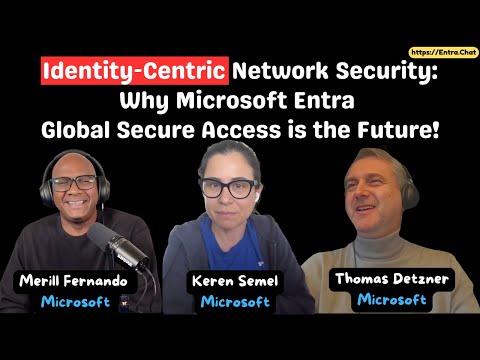
Overview of the Video
In a recent YouTube episode hosted by Merill Fernando, guests from Microsoft’s product and architecture teams unpack how Microsoft Entra Global Secure Access is reshaping enterprise network security. The discussion frames the shift away from hardware-centric models toward identity-driven controls and examines real-world use cases explained by Keren Semel and Thomas Detzner. As a result, viewers gain a clear picture of how Microsoft positions the product within modern security stacks and why this matters for hybrid workforces. Overall, the video aims to translate dense terminology into practical steps for IT teams.
From VPNs to Cloud-Native Security
The hosts argue that the era of classic VPNs, firewalls, and static DMZs is winding down because these controls are often too coarse and lack continuous identity context. They note that the pandemic exposed scalability limits in legacy gateways, which struggled when remote work abruptly surged, and this accelerated adoption of cloud-first approaches. Consequently, solutions such as SASE and SSE have gained traction because they push security enforcement to distributed cloud edges rather than backhauling traffic to a central headquarters. This shift reduces latency for remote users and supports more granular, identity-aware access policies.
However, the speakers also highlight tradeoffs: moving controls to the cloud can create concerns about data locality, inspection scope, and vendor lock-in. While cloud routing often improves performance by using global edges, organizations must balance this with regulatory needs and selective inspection to avoid overreach into employee privacy. Thus, enterprises face a choice between a simpler, centralized control plane and a finely tuned, compliant inspection strategy that respects regional rules. Transitioning requires careful planning to reconcile performance, privacy, and governance goals.
What Microsoft Entra Global Secure Access Offers
The video breaks down the core components of Entra Global Secure Access into understandable building blocks, including Entra Private Access for zero trust network access to private resources and Entra Internet Access functioning as a secure web gateway for outbound traffic. Together, these elements sit within the broader Entra Suite, which combines identity governance, Verified ID, and protection capabilities. By presenting these as a converged suite, the presenters emphasize unified policy enforcement across both internet-bound and private resource traffic. This approach simplifies the admin experience while enabling conditional rules to act on live network sessions.
In practical terms, the platform supports both client-based agents for managed devices and clientless options for contractors, which speeds pilot projects and proofs of concept. The presenters shared that some customers reach a working PoC within days, not months, when they follow Microsoft’s deployment guides. Yet, simplicity for pilots does not eliminate the need for careful architecture, such as integrating with existing observability tools and planning for staged migrations from other vendors. Hence, organizations must manage the technical and operational workstreams together.
Identity-First Integration: The Secret Sauce
One of the most emphasized themes in the video is that GSA is not merely connected to the identity system; it is built as part of the identity plane itself. This design means that conditional policies and token revocations have immediate effects on network sessions, so a detected compromise can lead to instant tunnel termination or step-up authentication. As a result, security teams can respond in near real time without relying solely on network-layer controls or session timeouts. This tight integration brings identity signals directly into network decisions, closing gaps that legacy systems leave open.
Nevertheless, the integrated model brings its own challenges, such as ensuring consistent telemetry across identity and network logs and preventing single points of failure. Teams must also consider how deep identity integration affects legacy applications and custom authentication flows. Therefore, while identity-first enforcement improves responsiveness, it also requires mature identity governance and robust incident playbooks. Organizations should weigh the benefits of speed and precision against the operational discipline required.
Deployment, Tradeoffs and Challenges
The discussion covers practical deployment topics and the realistic tradeoffs organizations encounter when adopting GSA. On the positive side, leveraging Microsoft’s global private network can reduce latency and simplify routing, while administrators retain granular control over which traffic gets inspected to meet compliance demands. On the other hand, moving inspection away from local gateways raises questions about data residency and monitoring scope that teams must address through policy design and technical controls.
Operationally, migration paths from incumbent vendors require careful sequencing to avoid service disruption, and integrations with SIEM and CASB products need testing during pilots. In addition, balancing user experience against strict security rules means tuning policies to avoid excessive friction for low-risk workflows. Overall, the video makes clear that the technical benefits of Global Secure Access are substantial, yet realizing them depends on thoughtful planning, robust governance, and a willingness to adapt operational practices.
Implications for IT Teams
For IT and security teams, the episode offers both inspiration and pragmatic guidance: identity-driven, cloud-native network controls can improve security posture and user performance, but they require joint planning across identity, networking, and privacy groups. Teams should start with small, measurable pilots, validate telemetry and incident response, and iterate on policies to balance protection with usability. By doing so, they can transition from fragile, hardware-dependent architectures to more resilient, observability-rich systems.
In conclusion, Merill Fernando’s video presents Microsoft Entra Global Secure Access as a strong step toward a unified identity-and-network approach, while reminding viewers that careful tradeoff analysis and disciplined rollout plans are essential for success. The conversation helps decision makers weigh operational complexity against the benefits of faster response, lower latency, and finer-grained control. Ultimately, the shift is promising, but it calls for thoughtful adoption rather than a rushed replacement of existing infrastructure.