Microsoft AI: Boost Team Collaboration
Technical Specialist, Business Applications at Microsoft.
Microsoft lead on multi agent systems and agent orchestration with GitHub Copilot and Azure for enterprise AI governance
Key insights
- Simon Lacasse (Microsoft GBB) explains how multi-agent systems move from research to real-world enterprise use.
He frames agents as coordinated AI teammates that solve complex, multi-step tasks together. - Agent orchestration acts like a project manager for agents, coordinating order and timing of tasks.
Orchestration can be deterministic or dynamic, and run agents in parallel or sequentially depending on the workflow. - New protocols such as MCP and A2A enable agent-to-agent and model-to-tool communication across systems.
These standards create a scalable "internet of agents" by letting agents discover tools and share context without bespoke integrations. - Enterprises can achieve real scalability and business impact today by using modular agent designs and clear interfaces.
Examples include toolchains where GitHub Copilot behaves as a multi-agent feature that amplifies developer productivity. - Practical rollout starts with architecture, grounding, and governance: define small subagents, instrument logs, and set access controls.
Favor modularity over monoliths to simplify updates and reduce integration risk. - Common myths about cost and complexity often overstate barriers; proper design lowers both.
Simon recommends breaking problems into smaller pieces to avoid "giant prompts" and to improve agent reliability and maintainability.
Overview
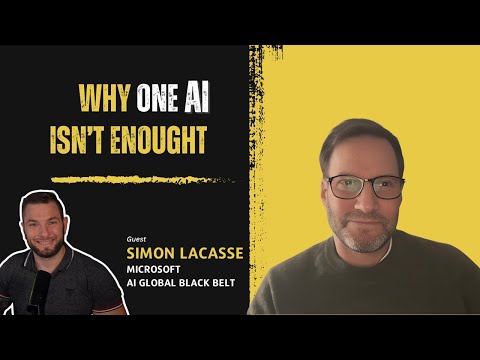
Samuel Boulanger summarized a recent YouTube episode that features Simon Lacasse, Microsoft’s Global Black Belt for AI, in a post that aims to make enterprise-scale collaboration with AI easier to understand. The video presents how teams can combine human skills with intelligent agents to solve complex business problems. In short, the episode argues that the shift today is toward smarter ecosystems rather than just smarter models, and that practical deployments are already happening in production settings on Compute.
What the Video Covers
The episode lays out concrete topics, from what agent orchestration means to why tools like GitHub Copilot behave like multi-agent systems. Simon Lacasse explains the mechanics behind multi-agent setups and differentiates deterministic orchestration from dynamic orchestration, as well as parallel from sequential flows. He also details where organizations typically begin: architecture, grounding, Developer Tools, and governance.
Key Technologies and Protocols
The discussion highlights two protocols that matter for agent ecosystems: MCP (the Model Context Protocol) and A2A (agent-to-agent communications). These standards help agents share context, call tools, and manage interactions without each integration becoming a custom project. As a result, teams can avoid brittle point-to-point connections and instead compose agents that interoperate across services and tools.
Practical Advantages and Use Cases
According to Lacasse, multi-agent architectures make long-horizon tasks and cross-tool workflows feasible at scale, and enterprises are already seeing business impact. He points to real use cases where agents coordinate data queries (including analytics with Power BI), automate routine processes using Power Automate and Power Apps, and support specialist subprocesses, which reduces human toil. The video also suggests that automated logs and interaction records can serve as objective metrics for evaluating agent performance.
Tradeoffs: Modularity Versus Monolith
A significant focus of the episode is the tension between building many small specialized subagents and creating larger monolithic agents. Modularity allows clearer responsibilities, easier testing, and incremental upgrades, but it adds communication complexity and coordination overhead. On the other hand, monolithic agents can simplify orchestration but risk becoming brittle, harder to scale, and more expensive to change over time.
Operational Challenges and Governance
Lacasse addresses common concerns about cost, complexity, and governance, noting that misconceptions can slow adoption. For example, firms often overestimate integration costs while underestimating the governance work needed to manage agent behavior and data access. He emphasizes that governance must balance safety and control with the agility teams need to iterate and deliver value quickly.
Balancing Determinism and Flexibility
The video distinguishes deterministic orchestration, appropriate for regulated or safety-critical flows, from dynamic orchestration, which supports creative and adaptive problem solving. Deterministic flows simplify verification and make audits easier, but they can limit agent autonomy. Conversely, dynamic orchestration can handle unexpected inputs and unknown tools, yet it requires stronger runtime checks and clearer observability to manage risks effectively.
Getting Started: Practical Steps
For teams ready to try multi-agent systems, Lacasse recommends phased work: define a small, meaningful use case; ground agents with clear data sources; choose interoperable tools; and put governance guardrails in place. He also suggests breaking large problems into smaller, testable parts and avoiding "giant prompts" so agents remain interpretable. This iterative approach reduces chaos and helps organizations discover where agents deliver the fastest business value.
Future Outlook and Productivity Tips
Looking ahead, Simon Lacasse predicts a decade where human-agent collaboration reshapes work and daily life, with agents acting as specialized teammates. He offers productivity tips such as decomposing tasks, designing clear agent roles, and using logs to measure success instead of relying solely on subjective review. Finally, the episode argues that adopting standards and protocols will accelerate safe, scalable agent ecosystems across enterprises.
Keywords
AI collaboration strategies, Microsoft AI leadership, Simon Lacasse interview, enterprise AI collaboration, AI teamwork best practices, Microsoft GBB AI, collaborative AI tools, AI-driven business transformation