Microsoft Fabric: AI Reinvents Power BI
Founder | CEO @ RADACAD | Coach | Power BI Consultant | Author | Speaker | Regional Director | MVP
Microsoft expert explores Power BIs future in Fabric, covering Copilot, Semantic Views, Fabric web app and prompt-first UI
Key insights
- Power BI future overview: Mohammad Ali explains where Power BI is heading and how it fits inside Microsoft Fabric.
He highlights recent shifts toward AI, web-first workflows, and tighter integration across analytics tools. - Semantic Views: a shared metadata layer that makes models consistent and reusable across teams.
Semantic Views simplify report building, speed up analysis, and improve governance by centralizing business logic. - Fabric Web App and Direct Lake: the browser-first experience brings more work into the web with faster live queries from OneLake.
Direct Lake reads Delta tables directly so reports feel as fast as imported data without duplicating it. - Copilot in Power BI: conversational AI that generates visuals, DAX, and narrative summaries from natural-language prompts.
Copilot-for-visualization builds charts from descriptions, while reusable AI skills support repeatable transformations and features inside reports. - Power BI Desktop updates and prompt-first ideas: Desktop gains tighter live editing and sync with the service, plus better history and collaboration.
The team is exploring prompt-first interfaces, but will keep power-user capabilities while adding natural-language workflows. - Version history and collaboration: OneDrive-based versioning, Git integration, and Task Flows improve teamwork and deployment.
Automatic mobile layouts and service updates make reports easier to share, govern, and maintain across organizations.
Introduction
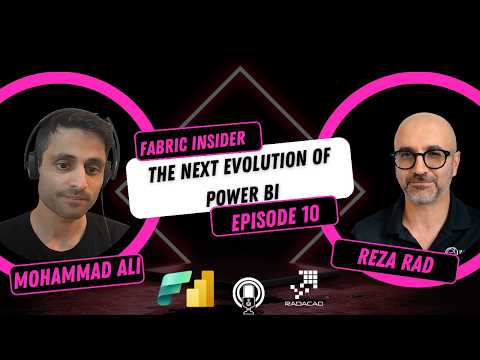
In a recent episode of the Fabric Insider series, Reza Rad (RADACAD) [MVP] hosted Mohammad Ali, Director of Product Management for Power BI, to discuss the platform’s future direction and how AI will shape business analytics going forward. The conversation covered a wide set of topics, including the rise of conversational assistance, the evolution of the web-first experience, and new capabilities such as Semantic Views and Direct Lake. As a result, the episode offers a practical look at where Microsoft is investing and how those investments may affect analysts and decision-makers. Consequently, teams that rely on Power BI and Microsoft Fabric should consider these developments when planning their analytics roadmaps.
Episode Overview and Key Announcements
Reza Rad guided viewers through a structured interview that highlighted both recent releases and the near-term roadmap, while Mohammad Ali explained the rationale behind each change. For example, Ali detailed updates in the Fabric web app experience and enhancements to version history using OneDrive, emphasizing smoother collaboration and better report lifecycle management. Moreover, the episode showcased how Copilot is being embedded for conversational report creation and ad hoc calculations, which aims to reduce friction for non-technical users. Together, these announcements frame a vision of analytics that is faster, more collaborative, and more accessible to business teams.
AI and Copilot: Productivity Versus Control
The discussion made clear that Copilot and other generative AI features will speed common tasks, such as generating visuals, drafting DAX, and producing narrative summaries, thereby lowering the skill barrier for many users. However, Mohammad Ali also acknowledged the need to balance automation with control, since automated suggestions can introduce errors or hide assumptions if users do not validate outputs. Therefore, organizations must pair these AI capabilities with governance and review practices so that productivity gains do not come at the cost of accuracy or compliance. In short, while AI promises major productivity wins, it also necessitates stronger review workflows and clearer ownership of analytic artifacts.
Semantic Views and the Fabric Web App Experience
One of the episode’s focal points was Semantic Views, a feature designed to make shared data models more discoverable and easier to consume across teams, which should reduce duplication and inconsistent metrics. Alongside this, the Fabric web app aims to make the browser the primary experience for many workflows, offering features like live editing of Direct Lake models and improved visualization tools without switching to Desktop. While these changes improve accessibility and collaboration, they also raise questions about migration and change management for organizations that rely heavily on desktop workflows and custom extensions. Thus, teams will need to weigh the benefits of centralized semantics and browser-first convenience against the cost of retraining and refactoring legacy reports.
Power BI Desktop, Direct Lake and Prompt-First Ideas
Mohammad Ali addressed the evolution of Power BI Desktop, explaining incremental updates and exploring whether a prompt-first user interface might ever become the default for complex analytics work. He described Direct Lake as a way to get import-like performance while querying data live from the lake, which reduces duplication but also places more demand on upstream data design and storage performance. While a prompt-first UI could simplify many tasks, it risks sidelining advanced users who depend on granular controls and established development flows, so Ali suggested that hybrid approaches are more realistic in the near term. Ultimately, organizations must choose between convenience and control, and many will adopt mixed strategies that preserve advanced capabilities while offering simpler conversational paths for business users.
Tradeoffs, Challenges and What to Watch
The episode underscored several tradeoffs that organizations will need to navigate, most notably the tension between rapid AI-driven creation and the governance required to keep analytics reliable and auditable. Performance tradeoffs also appear when teams decide between Direct Lake for real-time access and traditional import models for isolated performance guarantees, so architectural planning remains crucial. Moreover, UI evolution toward prompt-first interactions will require investments in context retention, prompt design, and user education to avoid inconsistent outputs and misinterpretations. Going forward, teams should monitor how Microsoft refines Copilot’s context handling, how Semantic Views scale in large enterprises, and how the Fabric web experience interops with existing desktop and CI/CD workflows.

Keywords
Power BI AI, Microsoft Fabric, AI in Power BI, Fabric Insider podcast, Mohammad Ali Power BI, Next evolution of Power BI, Generative AI analytics, Data analytics with AI