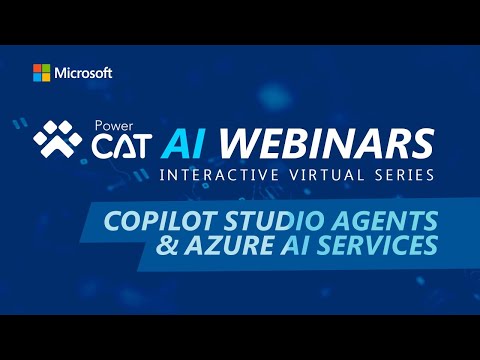
Copilot Studio: Extend Agents with Azure
Software Development Redmond, Washington
Microsoft expert: extend Copilot Studio agents with RAG via Azure AI Foundry and Azure AI Search and Power CAT webinars
Key insights
- Video focus: This YouTube video shows how to extend Microsoft Copilot Studio agents using Azure AI Foundry and Azure AI Search to add retrieval-augmented generation (RAG) and stronger grounding.
- Retrieval-Augmented Generation (RAG): RAG lets agents pull in proprietary and external documents at query time, improving accuracy and relevance of answers by combining retrieval with generation.
- Azure AI Foundry & Azure AI Search: The demo creates an AI Search service, builds an index in Azure AI Foundry, and uses Search to feed grounded content into the agent’s responses.
- Multi-agent orchestration: The new approach enables multiple agents to delegate and coordinate tasks (for example, fetch CRM data, draft a document, then schedule a meeting) to automate end-to-end workflows.
- Integration and governance: Agents work with Microsoft 365 apps, SharePoint, Dataverse, and custom APIs while Azure services provide model control, secure data access, and enterprise governance.
- Practical steps shown: The video walks through creating the AI Search service, indexing content in Foundry, and connecting a Copilot Studio agent to implement a RAG scenario; it also references a prior demo that covers bringing your own model to Copilot Studio.
Video summary
The YouTube video, produced by Microsoft, demonstrates how to extend a Copilot Studio agent using Azure AI services. It specifically walks viewers through adding retrieval-augmented generation (RAG) and more robust grounding by using Azure AI Foundry together with Azure AI Search. Consequently, the demo shows steps such as creating an AI Search service, building an index in Foundry, and linking the index to a Copilot Studio agent to enable a RAG scenario. Overall, the video acts as a practical guide for teams that want to bring richer knowledge and better grounding into Copilot-based agents.
Moreover, the presenter references a companion demo that explains how to "bring your own model" from Azure AI Foundry into a Copilot Studio agent, which adds context for those who need custom model control. The video also briefly mentions related resources like Microsoft training webinars that help organizations adopt agent technology. However, the video focuses mainly on the hands-on connection between the search index and the agent rather than in-depth governance policies. As a result, viewers come away with a clear operational picture and a sense of where to go next to scale the approach.
How the integration works
First, the workflow begins by provisioning an Azure AI Search service and creating an index to store organizational content for retrieval. Then, the demo shows how to create an index inside Azure AI Foundry and populate it with documents so the agent can fetch context. Afterwards, the presenter configures the Copilot Studio agent to query the index at runtime, enabling RAG-style answers that combine model generation with retrieved facts. Therefore, the integration blends the conversational abilities of the agent with up-to-date, enterprise-specific knowledge.
Additionally, the video highlights how retrieval operations are invoked when the agent detects a need for external information, which reduces hallucinations and improves relevance. Meanwhile, Foundry helps manage indexing and embeddings so developers can control how documents map to vector space. In contrast to pure fine-tuning, this RAG approach keeps the base model flexible while relying on a searchable knowledge store for factual grounding. Consequently, teams can update knowledge stores independently of model retraining, which speeds maintenance and reduces cost.
Benefits and tradeoffs
The integration brings clear advantages, such as richer, context-aware responses that align with internal documents and systems like Microsoft 365. Furthermore, multi-agent orchestration now allows different agents to delegate tasks—one fetches data, another drafts content, and yet another triggers workflows—so organizations can automate end-to-end scenarios. However, these gains come with tradeoffs between ease-of-use and control: Copilot Studio offers low-code simplicity, while Azure AI Foundry provides deeper customization but requires more engineering effort. Thus, teams must balance fast deployment against the need for governance and fine-grained model management.
In addition, retrieval-based grounding reduces risk of incorrect outputs, yet its effectiveness depends on index quality and query design. For example, a well-curated index improves accuracy but increases the work required for document curation and embedding maintenance. Conversely, relying solely on model-based knowledge avoids indexing overhead but risks stale or hallucinatory responses. Therefore, organizations should weigh the cost of indexing and upkeep against the benefits of precise, auditable answers.
Challenges and practical considerations
Operational challenges include index maintenance, latency, and cost, all of which affect the user experience and total cost of ownership. For instance, frequent document updates demand re-embedding workflows and careful scheduling to avoid stale results, and high query volumes can raise search costs and response times. Security and compliance present further hurdles because retrieved documents may contain sensitive data that requires strict access controls and auditing. Consequently, teams must design authorization layers and retention policies to align with corporate governance.
Moreover, multi-agent orchestration introduces complexity in debugging and monitoring because multiple agents can interact in non-linear ways. In practice, tracing a failure across agents or between the agent and search service requires robust observability and clear error-handling patterns. In addition, teams must consider fallback strategies when retrieval returns insufficient context, such as asking clarifying questions or defaulting to a safe response. Ultimately, robust testing and staged rollouts help manage these risks while preserving the benefits of orchestration and RAG.
Adoption steps and outlook
For organizations ready to experiment, the video encourages starting with a small, well-scoped knowledge domain and simple agent behaviors to validate value quickly. Next, teams can scale by expanding indexes, adding more agents for specialized tasks, and introducing governance guardrails as needs grow. Meanwhile, Microsoft offers interactive webinars and training sessions that help organizations learn to adopt Copilot Studio and agent patterns in real deployments. Therefore, combining hands-on trials with guided learning provides a practical path toward broader adoption.
Looking ahead, the combination of Copilot Studio, Azure AI Foundry, and Azure AI Search points toward more interconnected, automated enterprise workflows driven by coordinated agents. However, realizing that future depends on careful tradeoffs between speed, control, and compliance, and it requires ongoing investment in data quality and observability. In short, the video supplies a useful technical starting point while highlighting the operational choices that organizations will need to make as they scale agent-based automation.
Keywords
Extend Copilot Studio agents, Copilot Studio Azure integration, Azure AI services for agents, Azure OpenAI Copilot Studio, Copilot Studio cognitive services, Build AI agents in Azure, Deploy Copilot agents on Azure, Copilot Studio agent extensions