Microsoft Foundry: New UI, IQ, Workflows
IT Program Manager @ Caterpillar Inc. | Power Platform Solution Architect | Microsoft Copilot | Project Manager for Power Platform CoE | PMI Citizen Developer Business Architect | Adjunct Professor
Explore Microsoft Foundry new UI, Foundry IQ, agentic retrieval, workflows, memory, publish to Copilot and Teams
Key insights
- Microsoft Foundry: A unified, enterprise-grade platform for building, deploying, and managing AI agents.
It supports multiple models (OpenAI, Anthropic) and lets teams run agents across Azure and Microsoft 365 with built-in lifecycle tools. - New UI & MCP tool catalog: The redesigned portal simplifies agent creation and connects agents to external tools via the Model Context Protocol (MCP).
Developers can use the Foundry VS Code extension and SDKs to deploy, debug, and manage agents from their IDE. - Foundry IQ & Agentic Retrieval: Foundry IQ powers retrieval-augmented generation and enables reliable cross-source grounding without upfront indexing.
Agentic Retrieval supports iterative retrieval and reflection to boost relevance and reduce hallucinations. - Multi-agent workflows: Foundry lets you design stateful, multi-step workflows that coordinate multiple agents inside the platform.
You can host agents on Microsoft infrastructure and publish them to Microsoft 365 Copilot and Teams for real-world use. - Agent Memory: Agents can store secure session context to maintain continuity across conversations and personalize responses.
This memory is built for enterprise security and reduces the need for external context stores. - Foundry Control Plane & Identity: A centralized control plane provides identity, policy, observability, and lifecycle management for agents.
It integrates with enterprise security tools and uses Entra Agent ID for secure agent identity and access control.
Video summary and context
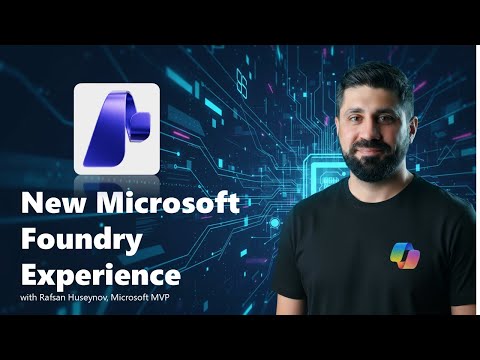
Rafsan Huseynov’s recent YouTube video offers a concise walkthrough of the newly rebranded Microsoft Foundry, unveiled at Microsoft Ignite 2025. The presenter guides viewers through the platform’s redesigned interface and highlights features like Foundry IQ, Agentic Retrieval, and built-in memory for agents. Consequently, the video serves as a timely primer for IT leaders and developers who missed the live event but want a practical view of the new offering. Overall, the coverage emphasizes how Foundry positions itself as an enterprise-grade AI agent factory rather than a simple rebrand.
Huseynov structures the video with clear timestamps that map to specific capabilities, which helps viewers jump to sections on UI, agent creation, memory, workflows, and publishing to Microsoft 365 and Teams. Moreover, he demonstrates the portal and developer tools, showing how the platform supports multi-model choices and integration with existing Azure services. In short, the video provides a hands-on perspective that complements Microsoft’s official announcements. As a result, it gives a useful, operational view for teams planning pilots or production deployments.
New user interface and developer tools
The video starts with a guided tour of the brand-new Foundry portal, where Huseynov highlights a cleaner layout and streamlined flows for building agents. He points out that the portal now integrates support for the Model Context Protocol (MCP), which helps agents connect to remote tools and contextual services. Furthermore, the demo includes the Visual Studio Code extension and updated SDKs that let developers deploy, debug, and manage agents directly from their IDE. These tools aim to reduce friction for engineering teams while increasing speed to prototype.
However, the improved UI and richer toolset introduce some tradeoffs for organizations. For example, faster prototyping can increase operational sprawl if governance is not applied from the start, and the addition of many features may raise the learning curve for smaller teams. Therefore, teams must balance usability against the need for training and centralized standards. In practice, adopting these tools will likely demand close coordination between platform engineers and security or compliance teams.
Foundry IQ and Agentic Retrieval
A central highlight of the video is the explanation of Foundry IQ, a capability focused on retrieval-augmented generation across multiple data sources without necessarily requiring upfront indexing. Huseynov demonstrates how Agentic Retrieval can iteratively pull and reflect on data from diverse repositories to ground responses more accurately. Consequently, agents can produce more relevant answers by combining retrieval steps with model reasoning, which is particularly useful in complex enterprise contexts. The explanation clarifies how this approach differs from simple keyword search and basic RAG pipelines.
Still, this design brings tradeoffs worth noting. Although skipping full indexing reduces setup time, it can increase latency and resource use during live queries, and it may demand careful tuning to avoid noisy or irrelevant results. Moreover, cross-source grounding raises questions about data freshness and lineage, so organizations must invest in observability and metadata management. Therefore, teams should plan retrieval strategies that balance speed, relevance, and traceability for their use cases.
Agent workflows, memory, and deployment
Huseynov then explores how Foundry supports multi-agent workflows and introduces agent memory in public preview, which allows agents to retain conversational context securely. He shows how hosted agents and workflow orchestration let teams run complex, stateful processes directly in the platform, and how agents can be published to Microsoft 365 and Teams for end-user experiences. This integration promises smoother deployment paths for enterprise scenarios, particularly when connecting agents to productivity tools through Agent 365. Consequently, organizations gain a more direct route from development to user-facing deployment.
Nevertheless, memory and persistent context create hard choices about privacy, retention policies, and data residency. While Entra Agent ID and other identity features help enforce access controls, architects must design memory models that meet regulatory and security requirements. Additionally, orchestrating many stateful agents can complicate observability and debugging, so teams should invest in testing frameworks and telemetry early. In short, the benefits of richer interactions come with operational and compliance responsibilities.
Governance, tradeoffs, and challenges
Finally, Huseynov highlights governance features such as the Foundry Control Plane, which centralizes identity, policy, and observability while integrating with Defender and other Microsoft security tools. This centralized approach can simplify lifecycle management and compliance reporting, especially for large enterprises that require strict oversight. However, centralization also risks creating single points of policy bottlenecking, and it can demand significant initial setup and coordination across teams. Therefore, organizations must weigh the governance benefits against the overhead of implementing consistent controls.
In conclusion, the video by Rafsan Huseynov offers a practical tour of Microsoft Foundry and explains core innovations with useful demos and clear commentary. While the platform adds powerful capabilities for building and deploying AI agents, it also raises tradeoffs around complexity, latency, and governance that teams must manage. For readers planning a pilot, the video provides both inspiration and a realistic checklist of technical and organizational challenges to address. Overall, Huseynov’s walkthrough is a balanced resource for decision-makers and practitioners evaluating Foundry for enterprise AI initiatives.

Keywords
Microsoft Foundry, Foundry IQ, Microsoft Foundry UI, Foundry workflows, Agentic retrieval, Foundry memory, Foundry agentic workflows, Microsoft AI Foundry