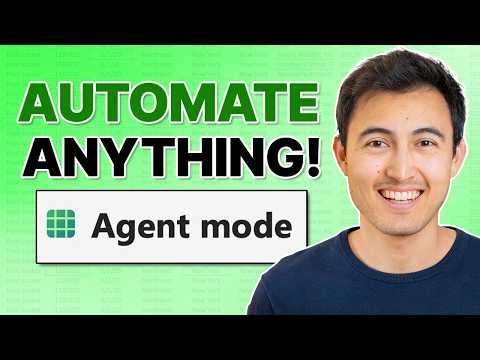
Excel AI Agent Mode: Automate Tasks Fast
Co-Founder at Career Principles | Microsoft MVP
Excel AI Agent Mode builds dashboards and finance models via natural language and Office Agent for PowerPoint Word
Key insights
- AI Agent Mode: A new Excel feature that lets you work with spreadsheets using natural language instructions.
Tell Excel what you want and it builds tables, formulas and visuals for you automatically. - Copilot: The conversational assistant that runs side-by-side in Agent Mode to guide multi-step tasks.
It accepts plain-language requests and executes complex sequences like model building or data reshaping. - Native Excel features: Agent Mode creates results using existing Excel tools such as formulas, PivotTables, charts and conditional formatting.
Because it uses native features, outputs stay dynamic and update when source data changes. - Use cases: Practical examples shown include loan amortization tables, personal finance dashboards, consolidating multiple sheets, and discounted cash-flow (DCF) models.
These examples highlight how Agent Mode handles multi-step financial and reporting tasks. - Office Agent: A related agent that generates PowerPoint slides and Word reports quickly from the same conversational inputs.
It aims to speed report and presentation creation while letting you edit results manually. - Availability & limitations: Agent Mode is in preview (via Excel Labs) and currently available to select Microsoft 365 subscribers on Excel for the web in English.
Expect benefits in productivity, but plan to review outputs carefully—preview tools can still make errors on complex reasoning or edge cases.
Video Overview and Context
Microsoft Excel’s new AI Agent Mode, Kenji Farré (Kenji Explains) [MVP] posted a detailed YouTube walkthrough showing Microsoft Excel’s new AI Agent Mode, describing it as a major shift in spreadsheet workflows. In the video, he demonstrates how the feature lets users interact with files using natural language, and he frames the tool as part of Microsoft’s broader push to embed AI across its Office suite. Importantly, Farré notes that AI Agent Mode produces workbooks that rely on native Excel features, which keeps the output editable and dynamic. Consequently, the video positions the feature as a step toward more conversational and automated spreadsheet creation.
Live Demonstrations in the Video
Farré walks viewers through four concrete scenarios to show practical uses, beginning with a loan amortization table and moving on to a personal finance dashboard. Then, he demonstrates consolidating multiple sheets into one and building a discounted cash flow model, or DCF, from scratch. Moreover, he shows an Office Agent that generates PowerPoint slides and Word reports within seconds, illustrating cross-app automation. These examples aim to show both everyday tasks and advanced financial modeling done via plain language.
How It Works and Where to Find It
The video explains that AI Agent Mode works by interpreting natural language prompts and creating elements using Excel’s built-in tools such as formulas, tables, and PivotTables. Because outputs use native Excel constructs, they stay dynamic and update when source data changes, which Farré highlights as a key advantage for ongoing analysis. Currently, he reports the feature is available in preview through Excel Labs for users with certain Microsoft 365 plans, and it runs on Excel for the web in English. However, Farré also notes broader availability and language support are expected to expand over time.
Benefits Highlighted by the Presenter
Farré emphasizes improved productivity as the clearest benefit, arguing that automating repetitive steps frees analysts to focus on interpretation rather than construction. Additionally, because the agent writes formulas and builds pivot-ready structures, users can modify the results directly, preserving control and customizability. He also points out that the tool handles multi-step reasoning, chaining actions like reshaping data and inserting visualizations in a single flow. Therefore, teams that rely on frequent updates and collaborative workbooks may see quick gains in speed.
Tradeoffs and Practical Challenges
Despite the promise, the video also addresses important tradeoffs, starting with accuracy: AI-generated formulas can be efficient but sometimes miss edge cases or assume incorrect business rules. Furthermore, there's a tension between automation and oversight, because relying too heavily on the agent can obscure why a model behaves a certain way, which makes audits harder. Performance and privacy present additional challenges, particularly for large datasets or files containing sensitive information, since organizations must balance convenience with governance. Consequently, Farré recommends active human review and appropriate enterprise controls when adopting the feature.
Limitations, Next Steps, and Editorial Takeaways
Farré closes by discussing several limitations he encountered, which include preview-only availability, language restrictions, and occasional misinterpretations of complex requests. He suggests that users will need to refine prompts and validate outputs, and that Microsoft will likely iterate on accuracy and platform reach. For newsrooms and professionals, this means the technology can accelerate routine tasks, but human expertise remains essential for validation and context. Overall, the video presents AI Agent Mode as a powerful productivity aid that still requires careful, informed use.

Keywords
Excel AI Agent, Excel Agent Mode, Excel Copilot Agent, Excel AI automation, Excel generative AI features, Excel AI formulas, Excel productivity with AI, Office 365 Excel AI