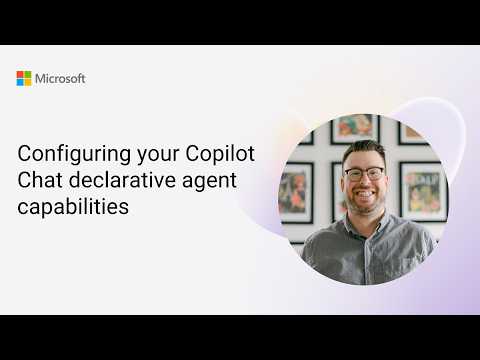
Copilot Chat: Set Up Declarative Agents
Software Development Redmond, Washington
Build context aware Copilot Chat declarative agents with Microsoft three sixty five data SharePoint Teams and Outlook
Key insights
- Declarative agents: Demo shows these are configuration-driven Copilot Chat assistants you build with manifests instead of heavy custom code.
They let teams create tailored, consistent experiences across Microsoft 365 apps quickly. - Declarative agent manifest: The manifest defines instructions, knowledge sources, actions, and capabilities and ships in the agent app package.
Use it to control behavior, prompts, and which features the agent can access. - Knowledge sources: Ground agent answers in enterprise content such as SharePoint sites, Teams chats, Outlook mail, files, or selected web pages.
Limiting and focusing sources improves relevance and performance. - Built-in capabilities: Capabilities like the Code Interpreter and Image Generator extend the agent for data analysis or image creation; availability can depend on user licensing.
Enable only needed capabilities to keep responses safe and predictable. - Actions / APIs: Integrate external systems with Copilot connectors, custom web APIs, or Power Platform connectors mapped via OpenAPI documents.
Mark risky operations as isConsequential to require careful handling and approval. - Testing, deployment & best practices: Admins publish agents from the Microsoft 365 admin center and test them in Agent Builder’s preview or by provisioning to Copilot Chat.
Use the Microsoft 365 Agents Toolkit and VS Code for source control, test iteratively, and keep documents focused for best performance and governance.
Video at a glance
The Microsoft demonstration video, presented by Sébastien Levert during the Microsoft 365 & Power Platform community call on March 17, walks viewers through configuring a Copilot Chat declarative agent. The presenter uses real Microsoft 365 data sources such as SharePoint, Teams, Outlook email, and people profiles to show how an agent can be grounded in enterprise data. In turn, the demo aims to show how to turn a generic assistant into a reliable, context-aware helper across daily workflows.
Moreover, the walkthrough highlights practical tools like the Agent Builder test chat and the Microsoft 365 Agents Toolkit, showing how teams can iterate without rebuilding the entire AI stack.
Key elements shown in the demo
Levert begins by explaining the role of the declarative agent manifest, which declares the agent’s instructions, knowledge sources, actions, and capabilities instead of hard-coding them. He demonstrates how to connect knowledge such as SharePoint libraries or Teams chats so the agent answers from up-to-date, organization-specific content. Then, he configures built-in capabilities like the Code Interpreter and the Image Generator to extend what the agent can do beyond plain conversation.
As a result, the demo emphasizes that a declarative approach lets administrators and developers manage behavior, permissions, and actions centrally while keeping the agent aligned with corporate policies and data boundaries.
Technical workflow and configuration steps
The video walks step-by-step through packaging an agent as an app that contains both the app manifest and the declarative manifest, and it shows where to define knowledge sources and actions. Integrations with external systems appear as actions mapped to API operations defined with OpenAPI documents, and the presenter points out how to mark risky operations with an isConsequential flag to require extra safeguards. He also shows testing in the Agent Builder preview to validate prompts, edge cases, and access rules before releasing the agent to users.
Furthermore, the demo covers how admins control agent availability through the Microsoft 365 admin center and how license differences shape what features different users can access, which keeps governance straightforward in larger organizations.
Tradeoffs and balancing decisions
Levert’s demo makes clear that configurability brings tradeoffs between speed and precision: limiting the agent’s knowledge to focused documents improves performance but risks missing broader context when users ask unexpected questions. Conversely, opening access to many sources gives richer responses but increases processing cost and the chance of returning irrelevant or outdated information. Therefore, teams must balance breadth of data with response quality and cost controls.
Another key tradeoff involves automation versus safety; enabling consequential actions like creating or deleting records boosts productivity, yet it raises the risk of unintended changes. To manage this, the demo recommends strict use of flags such as isConsequential, careful API mapping, and layered approval or confirmation steps to keep automation helpful rather than harmful.
Challenges in deployment and ongoing maintenance
While the declarative approach reduces the need for heavy custom code, it also introduces new operational challenges such as keeping manifests current, managing permission boundaries across SharePoint and Teams, and troubleshooting failures in composed actions. Mapping actions to APIs and writing clear, testable prompts requires collaboration between IT, developers, and business owners to avoid mismatches between what users expect and what the agent can safely do. Moreover, ensuring data freshness and handling rate limits or token-size constraints remain practical hurdles when grounding answers in large document sets.
Finally, the demo highlights that rigorous testing and staged rollouts are essential. Teams should validate not only typical queries but also edge cases and error states, because missteps in automation can have outsized business impact; therefore, operators must build robust logging and monitoring to catch problems early.
Implications for adoption and next steps
The video positions declarative agents as a practical middle ground between low-code configuration and full custom builds, allowing organizations to reuse Microsoft’s AI orchestration while tailoring behavior through manifests. Consequently, groups that prioritize quick iteration and governance can deploy domain-aware assistants with less engineering overhead, while teams needing deep custom logic may still choose to code. In either case, the demo suggests starting small, focusing knowledge on targeted documents, and expanding capabilities as confidence grows.
In summary, the community demo provides a clear, actionable roadmap for setting up a grounded Copilot Chat agent: it shows the building blocks, surfaces tradeoffs, and stresses testing and governance so organizations can move from pilot to production with fewer surprises.

Keywords
Copilot Chat declarative agents, configure Copilot Chat, declarative agent capabilities Copilot, Microsoft Copilot agent configuration, set up declarative agents Copilot Chat, Copilot Chat declarative agent tutorial, Copilot agent best practices, Copilot Chat configuration guide