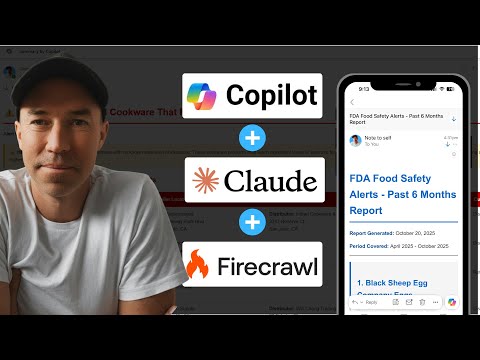
Claude Sonnet 4.5: Web Scraping Agent
A Microsoft MVP 𝗁𝖾𝗅𝗉𝗂𝗇𝗀 develop careers, scale and 𝗀𝗋𝗈𝗐 businesses 𝖻𝗒 𝖾𝗆𝗉𝗈𝗐𝖾𝗋𝗂𝗇𝗀 everyone 𝗍𝗈 𝖺𝖼𝗁𝗂𝖾𝗏𝖾 𝗆𝗈𝗋𝖾 𝗐𝗂𝗍𝗁 𝖬𝗂𝖼𝗋𝗈𝗌𝗈𝖿𝗍 𝟥𝟨𝟧
Copilot Studio agent uses Claude Sonnet and Firecrawl to autoscrape FDA alerts and send HTML email via MCP servers
Key insights
-
Claude Sonnet 4.5, Firecrawl and Copilot Studio form an auto web scraping agent stack that scrapes sites, analyzes content, and produces formatted reports.
The setup runs inside Copilot Studio and automates end-to-end data collection and reporting. -
The model offers strong reasoning and long-context handling with a 200K token context, plus tools for checkpointing and memory so agents keep state across long tasks.
This improves accuracy on complex, multi-step workflows and coding tasks. -
Firecrawl provides automated web-scraping through custom connectors, letting agents extract structured data without hand-writing scraper code.
Agents can visit pages, parse fields, and return clean data ready for downstream use. -
The demo workflow runs on just three instructions: find recent alerts, open each page, and extract key details. The agent then creates HTML email reports and tables from the scraped data.
It processes multiple URLs, shows intermediate reasoning, and delivers formatted results automatically. -
Integration with Microsoft 365 apps and multi-model support lets enterprises mix models for performance and compliance while keeping strong governance controls.
That makes the system fit into existing productivity and security workflows. -
Practical benefits include faster automation for research, competitive intelligence, and report generation, plus near real-time data updates that reduce manual work and speed decision-making.
The approach scales to many sites and repeated reporting tasks.
Daniel Anderson [MVP] published a YouTube video demonstrating an AI-powered web scraping agent that combines Claude Sonnet 4.5, Firecrawl, and Microsoft's Copilot Studio. In the video, Anderson walks viewers through setting up the agent, connecting tools, and running a real-world test that extracts safety alerts from a government website. He times the workflow carefully and shows how the agent processes multiple pages, extracts structured data, and then sends formatted HTML reports by email. Consequently, the demo offers a clear look at how modern LLMs can orchestrate web automation tasks from end to end.
Overview of the Demonstration
Anderson begins with a setup segment that configures Claude Sonnet 4.5 in Copilot Studio and adds connectors and servers, a process he completes in under two minutes on-screen. Next, he explains the three simple instructions that drive the agent and then tests it on FDA safety alerts from the last six months. Throughout the run, the agent shows its reasoning steps and visits each alert page to extract key fields. By the end of the demo, viewers receive an email with a polished, human-readable report and an HTML table of affected products.
How the Agent Works
The agent relies on Claude Sonnet 4.5 for advanced reasoning and long-context handling, enabling it to follow multi-step instructions without constant supervision. Meanwhile, Firecrawl handles the actual site navigation and extraction through custom connectors, which removes the need to write traditional scraping scripts. Anderson also uses MCP servers to manage email automation and other common tasks, which simplifies integration with enterprise workflows. Thus, the system stitches together model reasoning, scraping infrastructure, and automation tools into one pipeline.
Benefits and Real-World Use Cases
The demonstration highlights practical gains such as faster research cycles, automated monitoring, and instant report generation, all of which reduce manual effort for teams that need current web data. Furthermore, the agent’s long-context capability makes it suitable for complex research assignments that span many pages and require stateful memory. As Anderson shows, this setup works well for compliance monitoring, competitive intelligence, and regular data ingestion tasks. Therefore, organizations can use these agents to keep internal systems updated with external information without hiring specialized scraping engineers.
Tradeoffs and Challenges
Despite clear advantages, the approach involves tradeoffs between convenience and control. For example, while Firecrawl simplifies scraping, it introduces dependency on a third-party connector and requires robust governance around access and rate limits. In addition, long-context models like Claude Sonnet 4.5 can increase compute costs and complicate latency-sensitive workflows, so teams must balance accuracy with operational expense. Finally, automated scraping raises legal and ethical questions, which means enterprises must ensure compliance with site terms and data protection rules before deploying at scale.
Practical Considerations and Next Steps
Anderson emphasizes testing and incremental rollout: start with low-risk datasets, validate extractions, and audit the model’s outputs for hallucinations or missed fields. Teams should also plan for error handling when web layouts change and implement monitoring to detect extraction drift quickly. Moreover, organizations that need vendor diversity can leverage Copilot Studio’s multi-model capabilities to switch models based on cost, performance, or compliance requirements. In this way, enterprises can adopt these agents while preserving flexibility and control.
Overall, the video offers a practical, repeatable blueprint for building autonomous scraping agents that combine advanced LLM reasoning with dedicated scraping tools. While the demo focuses on a specific use case—FDA safety alerts—the pattern is broadly applicable and extendable to many monitoring, research, and automation scenarios. Consequently, teams evaluating AI-driven scraping should weigh the convenience against governance, cost, and legal constraints, and proceed with staged pilots to manage risk. In short, Anderson’s walkthrough presents both a promising toolset and a sensible roadmap for real-world adoption.
Related resources

Keywords
Claude Sonnet web scraping, Firecrawl web crawler, Copilot scraping agent, Auto web scraping agent, AI powered web scraper, Automated data extraction tool, Web crawler integration with Copilot, No code web scraping solution