Microsoft Fabric: 2026 Data Platform
Data Strategist & YouTuber
Hands on Microsoft Fabric build from scratch: Fabric Data Engineering and AI with DuckDB, ontologies and data agents
Key insights
-
Microsoft Fabric is a unified data and AI platform for analytics, real-time intelligence, and AI on a single lake.
In 2026 it centers on OneLake as the shared storage layer to avoid data duplication and speed collaboration. -
The video highlights modern tools like Osmos and agentic AI for automating data engineering tasks, plus utilities such as DuckDB for local analytics.
These tools speed pipeline creation and let you test AI-driven automation during the build. -
Real-time and warehouse upgrades matter: Real-Time Intelligence supports MQTT streaming and dedicated connectors, while the SQL engine gains result set caching and MERGE T-SQL.
These features deliver faster dashboards and smoother incremental loads. -
The recommended build steps are clear: provision capacity and workspace, ingest into OneLake, transform in a Lakehouse, create SQL pools and semantic models, then add AI and streaming.
Follow small, repeatable iterations and test each layer before scaling. -
Enterprise needs get attention: enforce data lineage, role-based access, and encryption like Customer Managed Key.
Developer productivity improves with ODBC drivers, CI/CD for APIs, and VS Code item management. -
The creator frames this as an experimental project to explore new Fabric and AI workflows and advises against copying the exact setup to production.
The series plans chapters that walk the build from planning to implementation and real-time testing.
Overview of the Video
In a recent YouTube presentation, Will Needham of Learn Microsoft Fabric with Will walks viewers through his plan to build a Microsoft Fabric data platform from scratch in 2026. He frames the project as experimental and practical, and he repeatedly warns that the techniques he tests are not yet recommended for production environments. Consequently, the video balances enthusiastic exploration with a clear caution to practitioners who are evaluating these approaches.
Needham outlines chapters that introduce the project, describe tool choices, state the guiding vision and principles, and set expectations for a multi-part series. He emphasizes that Microsoft Fabric now centers on the OneLake concept and that emergent AI tools are shaping how teams approach engineering, governance, and analytics. Thus, the video reads as both a how-to preview and a lab notebook for new Fabric capabilities.
Tools and Processes Highlighted
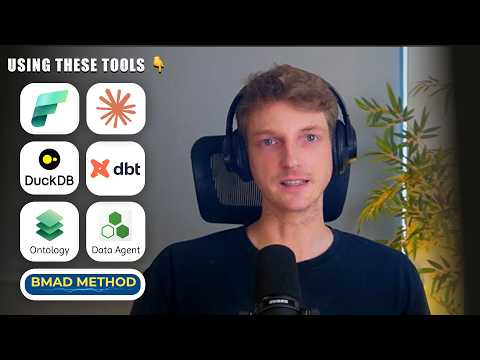
Throughout the presentation, Needham points to a blend of traditional and cutting-edge tools, including agentic AI and lightweight engines. Notably, he mentions technologies such as Osmos, Claude Code, DuckDB, BMAD, and data Agents that aim to speed data preparation and orchestration. He also stresses the role of ontologies to improve semantic consistency across datasets.
Moreover, Needham describes Fabric features that enable real-time and large-scale operations, such as improved streaming connectors, better date-time filtering for shortcuts into OneLake, and SQL enhancements like MERGE and result-set caching. As a result, these additions promise faster dashboards and more efficient compute usage, though they also increase the number of architectural choices teams must weigh.
Practical Steps and Roadmap
In practical terms, Needham recommends starting with a Fabric capacity and a workspace provisioned to use OneLake as the centralized data store. From there, he outlines ingest patterns that include batch copies and streaming ingestion, followed by transformation in lakehouses or notebooks and then warehousing for semantic models. He also notes the importance of integrating CI/CD tooling, modern drivers for connectivity, and developer extensions to reduce friction.
He sequences the work into clear phases: provision, ingest, transform, warehouse, and then layer in AI and real-time features. Importantly, Needham suggests enabling caching and materialized views early to manage cost and performance, while using agentic tools selectively to speed repetitive engineering tasks. Therefore, teams should view this roadmap as iterative rather than prescriptive.
Tradeoffs and Challenges
Needham explicitly acknowledges tradeoffs when adopting AI-native automation versus traditional manual pipelines. On one hand, agentic tools can accelerate development and reduce repetitive effort, but on the other hand, they may obscure logic, complicate auditing, and raise governance concerns. Thus, balancing speed with transparency and control becomes a central challenge for architects.
Another challenge concerns vendor alignment and skill sets: while OneLake and Fabric unify many capabilities, they also concentrate operations within the Microsoft ecosystem, which can simplify integration but increase lock-in risk. Additionally, real-time features boost responsiveness but require careful design to keep costs predictable and to avoid data quality pitfalls. Consequently, teams must trade agility for long-term maintainability.
Implications for Teams and Next Steps
For teams considering a similar build, Needham’s video functions as an instructional experiment that highlights both possibilities and hazards. He urges pilot projects, thorough testing, and conservative rollouts of agentic automation into production. By doing so, teams can validate performance benefits like caching and streaming while retaining the ability to revert to classical patterns if needed.
Finally, Needham frames the series as ongoing work that will continue to surface learnings about governance, cost control, and developer workflows. Therefore, readers and viewers should treat these episodes as a practical exploration that informs decisions rather than definitive best practices. Ultimately, the video offers a useful snapshot of how Microsoft Fabric in 2026 combines OneLake, AI, and real-time features to reshape modern data platforms.
Keywords
microsoft fabric data platform 2026, build microsoft fabric from scratch, microsoft fabric tutorial 2026, microsoft fabric architecture best practices, microsoft fabric deployment guide, microsoft fabric for data engineers, microsoft fabric end-to-end tutorial, microsoft fabric step-by-step setup