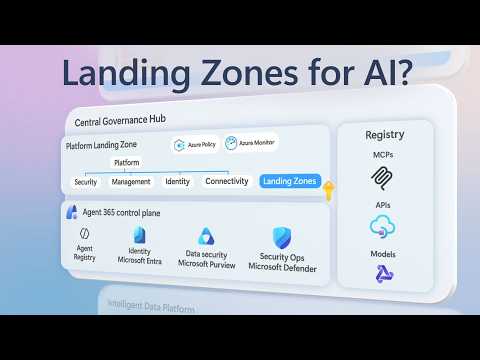
Azure Agent Architecture via AI Zones
Software Development Redmond, Washington
Scale secure AI agents on Azure with Microsoft Fabric ontologies and Purview governance via AI Landing Zone
Key insights
- AI Landing Zone: The video explains a reference architecture that treats AI agents as production workloads with built-in governance.
It helps teams deploy agents quickly while keeping identity, safety, and oversight in place. - Two‑plane architecture: The design separates the control plane (identity, policy, safety, evaluation) from the runtime plane (model inference and agent execution).
This lets organizations scale agent runtimes across regions while enforcing global policies. - Governance Hub and Agent 365: Centralize model access, policy enforcement, and catalogs in a shared hub and give each agent a traceable identity.
Agent 365 adds runtime protection and data governance so teams can audit and manage agent behavior. - Microsoft Fabric & Ontologies: Layer Fabric’s Ontologies and OneLake so agents reason over real business context instead of raw data.
That improves relevance and reduces errors when agents use enterprise data. - Runtimes and IaC deployment: Choose from no-code, hosted container, or custom runtimes and deploy with Infrastructure as Code using Bicep or Terraform.
The AI Landing Zone accelerator automates production-ready deployments in minutes. - Key benefits: Expect faster rollouts (the reference notes up to a 60% reduction in deployment cycles), built-in security and compliance, cost and performance monitoring, and modular scalability for evolving use cases.
Teams move from proof-of-concept to production faster while keeping control.
Overview of the Video
Microsoft published a YouTube video that outlines how organizations can build enterprise-ready AI agents on Azure, and the presentation features Matt McSpirit, an Azure expert, alongside Jeremy Chapman from Microsoft 365. In the video, presenters explain a reference architecture called the AI Landing Zone that treats agents as governable, production workloads rather than experiments. Moreover, they show how a centralized governance approach and a separate control plane can help teams scale agents across regions while maintaining oversight and compliance.
They also demonstrate practical tools and patterns, including identity controls, runtime protection, and data governance through what the video calls Agent 365. In addition, the presenters highlight integrating Microsoft Fabric ontologies and OneLake to give agents meaningful business context instead of relying on raw data alone. Altogether, the video aims to show how enterprises can move from prototypes to production quickly while preserving security and cost controls.
Core Components of the Architecture
The architecture separates responsibilities between a global control plane and multiple runtime planes, and this design is central to the approach. The control plane manages identity, policy enforcement, and evaluation, while the runtime plane handles model inference, data flow, and agent execution in each region. Furthermore, an AI gateway or Model Gateway sits in the request path to enforce policies and provide observability consistently across deployments.
Microsoft also recommends Infrastructure as Code, using Bicep or Terraform modules to automate deployments and enforce standards from the start. Additionally, the stack can include Semantic Kernel for orchestrating agent behaviors as well as Microsoft Fabric services to layer ontologies and business-aware reasoning. As a result, teams can deploy repeatable, auditable environments that reflect organizational requirements rather than ad hoc setups.
Governance, Identity and Security
A major theme in the video is governance: the presenters show how to centralize model catalogs, policy rules, and access controls so organizations can avoid fragmented decision-making. They recommend centralized policy guards like Azure Policy and monitoring through Azure Monitor so that operational teams can detect drift and enforce guardrails automatically. Moreover, giving each agent a traceable identity via the control plane enables accountability and more straightforward auditing across regions.
However, centralization carries tradeoffs: while a shared Governance Hub improves consistency and compliance, it can introduce latency or create bottlenecks if not designed carefully. To balance these concerns, the architecture keeps policy and identity central but enforces limits locally in each runtime region to preserve performance. In practice, teams will need to tune the balance between strict global controls and regional autonomy depending on performance, privacy, and regulatory requirements.
Deployment Options and Runtimes
The video presents three runtime approaches: no-code hosted runtimes for quick adoption, hosted container runtimes for standardization, and custom runtimes for specialized needs. Each option offers different benefits: no-code accelerates rollout and lowers skill barriers, containers provide consistency and portability, and custom runtimes allow optimization for unique performance or compliance needs. Furthermore, Microsoft supplies an AI Landing Zone accelerator to reduce time-to-production, helping teams deploy a production-grade environment within minutes.
Still, choosing a runtime involves tradeoffs between speed, control, and cost. For example, no-code environments speed adoption but can limit fine-grained control over resource usage, whereas custom runtimes give complete control but require more engineering effort. Therefore, organizations should match runtime choices to use case criticality, operational maturity, and cost constraints while planning for monitoring and lifecycle management from the outset.
Tradeoffs, Challenges and Next Steps
While the architecture promises a 60% reduction in deployment cycles and better governance, it also raises implementation challenges that teams must manage. Integrating ontologies and business context from systems like Microsoft Fabric and OneLake improves agent reasoning but requires careful data modeling and stewardship to avoid semantic drift. Additionally, integrating tools like Microsoft Purview for data governance introduces complexity around classification and lineage that can slow early deployments if not planned properly.
Finally, successful adoption will depend on cross-team collaboration among security, data, and application teams, as well as investment in automation and observability. Although the approach concentrates control to reduce risk, organizations must still plan for scale, cost management, and ongoing evaluation of model behavior. Overall, the video provides a clear, practical path to move AI agents into production while acknowledging the tradeoffs and operational work required to keep them secure, compliant, and effective.

Keywords
AI landing zones, agent architecture, Azure AI landing zones, AI agent infrastructure, scalable agent architecture, deploy AI agents, cloud-native AI agents, enterprise AI landing zones