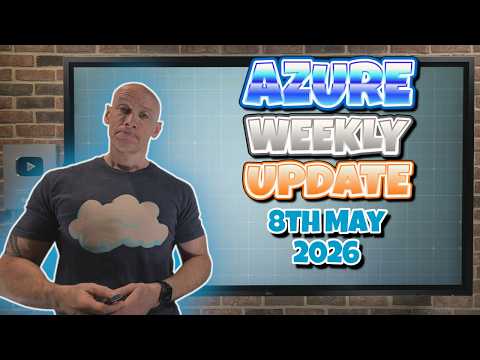
Azure Update 8th May 2026
Principal Cloud Solutions Architect
Azure update: Func scheduler & AKS App GW & Elastic SAN & ANF backup & Cosmos DB & GPT realtime & Doc Intelligence retires
Key insights
- Premium SSD v2 (Japan West, 3 AZs): Azure reached general availability for Premium SSD v2 across all three Availability Zones in Japan West.
These disks deliver high, predictable IOPS and throughput per GiB, support large disk sizes, and enable zonal redundancy for mission‑critical workloads. - GPT realtime models & Foundry: Microsoft added low‑latency GPT realtime models to Foundry and published updated "GPT‑chat‑latest" options.
Use these for live transcription, translation, and real‑time reasoning to improve responsiveness in meetings and customer interactions. - Elastic SAN and AVS Gen2: Elastic SAN now supports Gen2 private clouds for Azure VMware Solution and single‑volume snapshots.
These features simplify backups and boost storage efficiency for large block workloads in private cloud deployments. - Azure Cosmos DB updates: Cosmos DB introduced new vector search improvements and an interactive shell for management.
These changes improve vector search accuracy and make administration and ad‑hoc queries faster. - Backup and restore improvements: Azure Backup added bulk VM restore capabilities and enabled backups by default for supported Azure NetApp Files deployments.
These updates reduce recovery time and cut manual setup for protected workloads. - VM platform updates and retirements: Microsoft released Dsv/Edv v7 VM series for better single‑thread performance and energy efficiency, and announced reserved VM size retirements to streamline SKUs.
Plan migrations to v7 for improved price‑performance and review reservation changes to avoid disruption to long‑running instances.
Video summary and context
In a recent YouTube update, author John Savill's [MVP] walked viewers through a compact roundup of Azure changes and rollouts for early May 2026. He organized the episode with timestamps covering storage, compute, AI, databases, and operational notices, which makes it easy to jump to specific topics. Consequently, the video serves as a practical digest for cloud engineers and IT leaders who need to stay current without wading through multiple posts.
Moreover, Savill notes the channel has grown and that he can no longer respond to all questions directly, advising viewers to use community forums for help. He emphasizes subtitles and auto-translate features to reach non-English audiences, which broadens accessibility. Therefore, the update functions both as a technical summary and a pointer to further learning resources that the presenter maintains.
Storage and infrastructure advances
The video highlights that Azure Premium SSD v2 reached general availability across three Availability Zones in Japan West, improving zonal redundancy for high-performance workloads. This expansion matters because it reduces the risk of single-zone outages and allows enterprises in the region to architect more resilient systems. At the same time, Savill explains that Elastic SAN and new single-volume snapshot features expand options for large-scale storage deployments and backup strategies.
However, these storage gains come with tradeoffs: higher-tier disks deliver stronger IOPS and throughput but can increase costs and require planning for right-sized allocations. In addition, enabling features such as default backups for ANF (Azure NetApp Files) simplifies operations, yet it can complicate retention planning unless teams update governance and cost controls. Thus, teams must weigh resilience and performance needs against budgetary and operational complexity.
Compute platform updates and VM lifecycle
Savill covers new VM families including the v7 line for Dsv3, Dsv4, Dsv5, and the memory-optimized Ev and Ed series, which promise up to 20% price-performance improvement. These VMs leverage newer CPU designs to boost single-thread performance and energy efficiency, benefiting latency-sensitive workloads and modern AI-assisted tasks. He also flags reserved VM size retirements, which require customers to review reservations and potential re-sizing actions.
Balancing these compute upgrades involves tradeoffs between improved throughput and migration effort: moving to a newer VM family can reduce cost per unit of work, yet migration can disrupt workloads and require compatibility testing. Furthermore, the presenter mentions bulk Azure Backup VM restore improvements, which speed recovery but challenge teams to validate restore procedures regularly. As a result, organizations should plan phased migrations and rehearsal-driven disaster recovery exercises to limit surprises.
AI, databases, and realtime capabilities
The update spotlights real-time AI work in Microsoft Foundry, including low-latency services like GPT-realtime models and a new GPT-chat-latest offering for interactive scenarios. Savill explains that these advances enable live transcription, multilingual translation, and streaming inference, which help applications such as meetings and customer support become more responsive. He also mentions changes in database features such as Cosmos DB spherical quantization and a new shell experience, along with SQL Managed Instance memory right-sizing guidance.
Nevertheless, deploying realtime AI introduces challenges around cost, latency, and privacy: low-latency inference can demand more compute and careful regional placement, while data residency and governance remain essential when processing live streams. Transitioning to newer database features likewise offers performance benefits but requires schema and index tuning, plus validation to avoid regressions. Therefore, teams should prioritize controlled pilots and validate security controls when adopting these AI and database enhancements.
Operational changes, networking, and governance
Savill details several operational items including UK egress datacenter changes, an ACS AlternateId cleanup, and the App GW for Containers add-on becoming available for AKS. These changes reflect Azure’s ongoing work to refine networking, identity hygiene, and integration between container orchestration and application gateway features. He also calls out the retirement of Document Intelligence v3 APIs, prompting customers to plan migrations to newer API versions.
Operational shifts present tradeoffs between stability and modernization: updating APIs and cleaning alternate IDs improve security and future-proofing, yet they require time for code changes, testing, and stakeholder coordination. Likewise, network egress adjustments or private cloud AVS Gen2 announcements can change cost profiles and latency characteristics, so teams must revisit architecture diagrams and data flow maps. Consequently, clear change management and communication across teams remain vital to avoid service disruption.
Practical takeaways and recommended next steps
Overall, Savill’s update packages many incremental but meaningful changes that cumulatively affect cost, performance, and operational risk. He encourages viewers to search his channel for deeper dives and to use community forums for troubleshooting, which underscores the importance of collaborative learning in fast-moving cloud environments. For practitioners, the sensible next steps are to inventory impacted resources, run compatibility tests, and stage migrations to validate expected benefits.
Finally, while these Azure improvements offer better performance and features, organizations must balance immediate gains against migration effort, governance updates, and long-term costs. Therefore, a measured approach that pairs pilot projects with updated runbooks will help teams capture value without undue risk. In sum, the video provides a clear, practical briefing that helps technical leaders prioritize actions for the coming quarter.

Keywords
Azure update May 8 2026, Azure May 2026 release notes, Azure new features May 2026, Azure security updates May 2026, Azure pricing update May 2026, Azure AI updates May 2026, Azure management tools update May 2026, Azure roadmap May 2026