Azure Update - 5th December 2025
Principal Cloud Solutions Architect
Azure expert roundup: Blob SFTP resumes, Postgres Flex, Databricks serverless, Azure ML SDK end, confidential ledger
Key insights
- Security updates: Microsoft rolled out serverless protection in Defender for Cloud (preview) and made Kubernetes gated deployment generally available to block insecure images at deployment. New LDAP recommendations (signing, encrypted traffic, channel binding) improve directory security, and Defender for Cloud Apps now detects AI agents for integrated incident response.
- AI and model support: Foundry added Anthropic Claude Sonnet 4.5, Opus 4.1, Haiku 4.5 and Mistral Large 3 to broaden model choices. These additions help teams pick the best frontier models for production and analytics workflows.
- Networking improvements: Public preview of Standard NAT Gateway V2 brings zone-redundant outbound reliability, VPN Gateway throughput increased up to 20 Gbps, and Private Link scale rose to support thousands of endpoints. AKS gained eBPF host routing and Pod CIDR expansion to lower latency and boost cluster scale.
- Databases and storage: Azure Database for PostgreSQL Flexible Server added extensions like ip4r and credcheck, and PostgreSQL improvements (including pg_squeeze updates) reached wider availability. Blob SFTP resumable uploads improve large-file reliability, and new migration tools accompanied the Azure SQL Server 2025 release.
- Developer and platform tools: Azure Developer CLI (azd) advanced with GA container apps, layered provisioning beta, and an extension model. Logic Apps now supports AI and RAG connectors in GA, and Azure Databricks added serverless workspaces for simpler analytics workloads.
- Operational notices and regions: Azure announced the Perth Azure Extended Zone, lifecycle updates like Azure ML SDK v1 retirement, and hardware features such as confidential ledger support on MCP Server to meet regional and compliance needs.
Overview of the Update Video
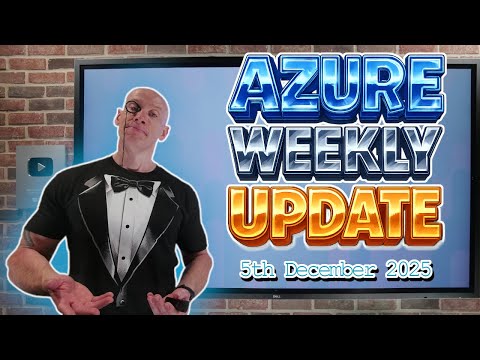
The latest YouTube briefing from John Savill's [MVP], titled "Azure Update - 5th December 2025 - 10% more fancy edition," delivers a concise walkthrough of product changes across Azure services. In the roughly eight-minute video, Savill highlights security advances, AI model additions, networking upgrades, and database improvements, presenting each item with practical context for administrators and architects. Consequently, the video serves as a useful roundup for cloud professionals who need to stay current without digging through dozens of release notes. Moreover, Savill includes short chaptered segments that make it easy to jump to specific topics like Blob SFTP and PostgreSQL extensions.
Security and Threat Protection
First, the video emphasizes several security gains within the platform, notably around Microsoft Defender for Cloud and related services. For example, serverless protection entered preview for both Azure and AWS workloads, and container deployment gate controls for Kubernetes became generally available, which helps enforce image security earlier in the delivery pipeline. These changes strengthen the cloud security posture, yet they also introduce tradeoffs because enforcing stricter checks can slow deployment pipelines unless teams invest in automation and pre-deployment scanning. Therefore, organizations must balance the benefit of earlier threat detection with potential impacts on developer velocity and pipeline complexity.
AI and Model Ecosystem
Next, Savill covers expansions in the AI ecosystem, where Microsoft Foundry added models such as Anthropic Claude Sonnet 4.5 and Opus 4.1 to its roster alongside existing offerings. This broader model support enables greater choice for customers who want to match models to workload characteristics, and it ties into integrations across services like Microsoft Fabric for analytics workflows. However, choosing between models introduces operational challenges, including cost management, latency tradeoffs, and governance for model outputs, so teams must adopt testing and monitoring routines. In short, greater choice boosts capability but increases the need for rigorous evaluation and lifecycle controls.
Networking and Scale Improvements
The video also highlights notable networking upgrades such as the public preview of Standard NAT Gateway V2 with zone-redundant architecture and a threefold throughput increase for VPN Gateway up to 20 Gbps. Additionally, Private Link scale limits were raised substantially, and new eBPF-based host routing for AKS promises lower latency and higher throughput for container workloads. While these enhancements address scale and reliability, they also raise complexity in network design and cost planning, particularly when teams need to weigh performance gains against operational overhead. Consequently, architects should evaluate new features in controlled pilots before broad rollout to avoid unexpected traffic patterns or bills.
Database and Storage Advances
On the storage and database front, Savill notes a useful update that Blob SFTP now supports resumable uploads, which improves robustness for transferring large files. PostgreSQL Flexible Server gained important extensions like credcheck and ip4r, and support expanded into new regions, enhancing both capability and geographic reach. In parallel, Azure SQL Server 2025 surfaced with new migration tooling and REST APIs to simplify migrations, though some migration paths still demand detailed planning and temporary compatibility layers. Thus, while these upgrades reduce friction for many scenarios, teams must still plan for schema differences, downtime windows, and test migrations to guard against data loss or performance regressions.
Developer Tools and Operational Considerations
Finally, the update touches on developer experience improvements, including progress in the Azure Developer CLI (azd), Logic Apps support for AI connectors, and increased automation around provisioning. These enhancements aim to streamline cloud-native development and continuous delivery, but they also require organizations to update documentation and retrain staff to use new patterns effectively. Moreover, integrating AI and security features into pipelines adds governance questions about logging, explainability, and incident response, which teams must address as part of their operational playbooks. Therefore, leaders should balance short-term productivity gains with the long-term costs of maintaining and governing more sophisticated toolchains.
What This Means for Teams
Overall, the video by John Savill's [MVP] offers a clear snapshot of progress across security, AI, networking, and databases within Azure. While the updates deliver meaningful capabilities that improve resilience, scale, and choice, they also introduce complexity that demands disciplined planning and testing. Accordingly, teams should prioritize staged adoption, measure operational impacts, and invest in automation and governance to capture benefits without creating new risks. In conclusion, the December update is valuable for practitioners who want to evolve their cloud environments thoughtfully rather than chase every headline.

Keywords
Azure update December 2025, Azure December 5 2025 update, Azure 2025 features, Azure service updates December 2025, Azure security update 2025, Azure pricing changes 2025, Azure AI updates 2025, Azure release notes December 2025