Fabric Futures: Power BI & AI Trends
Founder | CEO @ RADACAD | Coach | Power BI Consultant | Author | Speaker | Regional Director | MVP
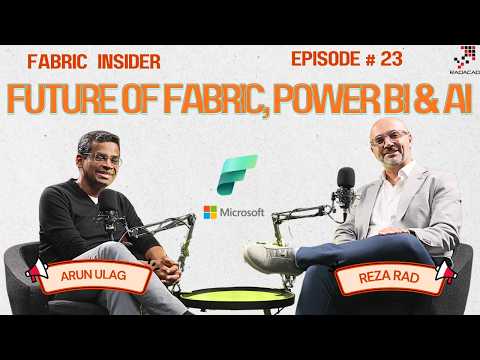
Microsoft Fabric and Power BI with Arun Ulag: Fabric IQ, Fabric App, enterprise adoption, Databricks vs Snowflake
Key insights
- Microsoft Fabric
Unified data and AI platform that combines data integration, engineering, warehousing, analytics and reporting in one environment.
It reduces handoffs and gives decision makers a single place for trusted metrics and governed data. - Power BI
Still the primary semantic and BI layer, now reusable as a foundation for apps and AI agents.
Analysts can start with trusted models and metrics instead of building apps from scratch. - Fabric IQ and OneLake
Fabric IQ adds business context, ontology, and metric definitions so AI answers follow company rules and meanings.
OneLake provides the unified data store that ensures data and context stay consistent across reports and agents. - Semantic models
Fabric’s honest differentiator is its integrated semantic layer: governed metrics and relationships that feed analytics, Copilot and agentic apps.
Databricks and Snowflake remain strong for raw engineering and storage, but Fabric focuses on operational context and reuse. - Government Cloud & enterprise readiness
Fabric now supports Government Cloud and enterprise security, showing it targets organizations of all sizes while meeting strict compliance needs.
Microsoft balances rapid feature delivery with enterprise stability through governance and observability features. - Skills for data and AI
Build expertise in semantic modeling, metric governance, OneLake data patterns, prompt design and agent workflows to stay relevant.
Focus on business outcomes and learn to turn trusted models into AI-assisted applications.
Introduction and context
Reza Rad (RADACAD) [MVP] published a blog post summarizing a YouTube video interview with Arun Ulag, EVP at Microsoft, recorded at FabCon Europe 2026 in Barcelona. The piece frames a wide-ranging conversation about the future of Fabric, Power BI, and AI, and it highlights practical questions that the data community has been asking. Moreover, the post makes clear that the discussion is aimed at decision makers, architects, and developers who must translate product announcements into real projects. Consequently, the article helps readers decide whether and how to move from reporting to a more integrated data-and-AI platform.
Defining Fabric from a business point of view
Arun Ulag describes Fabric not as a single tool but as a unified platform where data, semantics, and AI work together to serve business goals. In other words, Fabric is positioned as the place to store trusted data in OneLake, define metrics in Power BI models, and expose business meaning through Fabric IQ. This framing makes it easier to explain Fabric to non-technical leaders because it shifts the conversation from features to outcomes like consistent reporting, governed analytics, and AI that understands company rules. Therefore, leaders can evaluate Fabric on how it reduces decision friction rather than on raw technical specs alone.
From Power BI to Fabric: the journey and benefits
The blog post outlines why teams that currently rely on Power BI might expand into Fabric and what that path looks like. For one, Fabric lets organizations reuse semantic models and metrics across analytics and AI, so a dashboard’s trusted definitions become the starting point for agentic applications. Furthermore, Arun explains that this integration reduces duplicate work and improves governance, which matters for regulated industries and large enterprises. As a result, teams can move faster from ad hoc reports to governed, production-grade insights.
However, the move brings tradeoffs that the post covers candidly. For example, Fabric introduces more components and choices, which means teams must invest in platform design, security, and cost management. In addition, smaller teams may find the learning curve and initial setup heavier than sticking with a well-known reporting tool. Consequently, organizations must weigh the benefits of integration against the complexity and the need for new operational practices.
Fabric IQ, AI, and the promise of business-aware systems
One of the most significant themes in the video, as summarized by Reza Rad, is the role of Fabric IQ as a shared intelligence layer that adds business context to raw data. In practice, Fabric IQ pulls together definitions, ontologies, and access rules so that AI — including Microsoft Copilot and agents — can answer questions using the organization’s approved meanings. Moreover, this approach addresses a key enterprise AI problem: large language models alone may generate fluent text but lack the business rules and permissions that make answers reliable.
Nonetheless, delivering business-aware AI raises technical and governance challenges. Teams must map organizational concepts across systems, keep metrics synchronized, and ensure that privacy and access controls travel with the data. In addition, maintaining explainability and trust in AI outputs requires observability and verification workflows, which add operational overhead. Therefore, the promise of smarter AI comes with the responsibility to build robust guardrails and clear ownership.
Market positioning, enterprise adoption, and pace
Reza Rad also asks the tough questions about where Fabric stands relative to alternatives like Databricks and Snowflake, and Arun gives a candid response. He frames Fabric as an integrated option that prioritizes semantic consistency and developer velocity while still offering engineering-grade components like Spark. In contrast, best-of-breed platforms may win on specialized performance or ecosystem flexibility, which means the choice often comes down to tradeoffs between integration and heterogeneity.
Finally, the post examines how Microsoft balances rapid shipping with cautious enterprise adoption. Arun notes that enterprises move slowly for good reasons — compliance, scale, and risk — and that the company must deliver features safely while evolving quickly. The availability of Fabric in Government Cloud highlights that Microsoft aims to meet strict compliance needs even as it adds new capabilities. Thus, organizations should plan migrations carefully and expect a deliberate rollout rather than an overnight switch.
Career guidance, audience, and final takeaways
Arun’s advice, as relayed by Reza Rad, is practical: focus on core skills like semantic modeling, data governance, and applied AI, while staying adaptable to new interfaces and agentic workflows. For instance, report authors who learn to author reusable metrics and think in terms of business context will remain valuable as analytics and application development blur together. In summary, the episode is useful for Power BI developers, data engineers, architects comparing platforms, and BI leaders explaining Fabric to the business.
Overall, the blog post about the YouTube video provides balanced insight into the promise and the tradeoffs of moving toward a unified data and AI platform. It makes clear that Fabric is not a silver bullet but a strategic choice: it can reduce friction and add business intelligence to AI, provided organizations accept the operational work required to govern and trust their data. Consequently, viewers and readers should watch the full interview to assess how Fabric aligns with their goals and constraints.

Keywords
Arun Ulag Microsoft Fabric, Microsoft Fabric Power BI AI, Fabric Insider Ep 23, Future of Microsoft Fabric, Power BI AI integration, Arun Ulag interview Fabric, Microsoft Fabric roadmap, AI analytics in Power BI