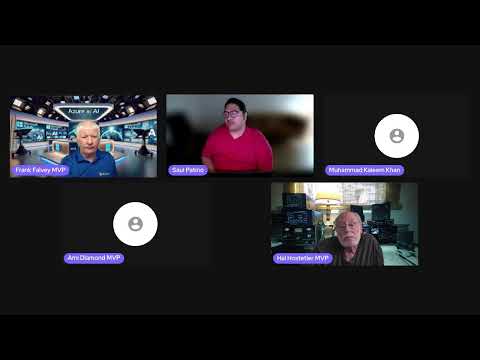
AI Show points to Microsoft AI learning
M365 Adoption Lead | 2X Microsoft MVP |Copilot | SharePoint Online | Microsoft Teams |Microsoft 365| at CloudEdge
Ami Diamond’s AI Show post is light on detail, but the linked Microsoft series focuses on practical AI demos and guidance.
Key insights
- The page title is AI SHOW, but the visible post text is only a StreamYard promotion.
- Research notes describe Microsoft AI Show as a Microsoft Learn video series.
- The series covers Azure AI, Copilot, AI agents, Phi models, and document intelligence.
- It is aimed at developers, engineers, and technical decision-makers.
- AI Builder is highlighted as a low-code way to automate document-heavy work.
Ami Diamond [MVP] recently published a post titled AI SHOW. The visible page text is very short and does not include a full transcript, but the surrounding research notes identify Microsoft AI Show as a Microsoft Learn video series focused on practical AI demonstrations, product updates, and technical guidance. The main takeaway is simple: this is less a news announcement than a pointer to Microsoft’s broader AI learning content.
The page itself contains a StreamYard promotional message, while the research notes fill in the subject area behind the title. That means readers should treat the available material as thin and use it mainly as a signpost to Microsoft’s AI learning resources rather than as a detailed product update. For teams following Microsoft’s AI stack, the relevant topic is the series’ focus on implementation, not just announcements.
What's new
The research notes describe Microsoft AI Show as a video series that explains Microsoft’s latest artificial intelligence technologies through demonstrations and technical guidance. Episodes commonly cover Azure AI, Microsoft Copilot, AI agents, computer vision, document intelligence, ONNX Runtime, and model deployment. The notes also say the series often includes product walkthroughs, sample architectures, and links to Microsoft learning resources.
Another theme in the notes is Microsoft’s emphasis on smaller models, especially the Phi family. These models are presented as useful for language and reasoning tasks while requiring fewer resources than very large models. The notes also mention AI Builder, Microsoft’s low-code AI service in the Power Platform, as a practical area where the show discusses document processing and automation.
Why it matters
For developers and technical decision-makers, the value here is context. Microsoft AI Show appears to frame Microsoft’s AI portfolio around deployment choices, model selection, and real business workflows rather than abstract theory. That matters if you are evaluating whether to build with Azure AI, Copilot-style experiences, or low-code automation in Power Platform.
For makers and administrators, the notes point to tools that reduce the amount of custom machine learning work needed for document-heavy processes. AI Builder is described as helping with extraction and classification tasks, which can support invoice handling, forms, and similar workflows. The material does not state licensing, availability, or rollout details, so those points remain unclear.
For end users, the connection is indirect but still relevant: these technologies are aimed at assistants, agents, and automation that can fit into everyday applications. The notes also suggest Microsoft is paying more attention to governance, security, and enterprise data grounding as AI becomes more operational.
How it works
The research notes describe the series as implementation-oriented. In practice, that means episodes tend to show how Microsoft technologies can be applied in real scenarios, rather than only explaining product names. The content commonly includes technical explanations, sample architectures, and demonstrations.
Where AI Builder is involved, the notes say it works as a low-code AI service inside Power Platform. It lets organizations apply prebuilt models to business processes without building machine learning systems from scratch. The result is that teams can automate tasks like document extraction and classification with less specialized AI development skill.
The notes also explain the difference between a simple chatbot and an AI agent. An agent can interpret a request, retrieve information, call an external service, and complete a multi-step task. That broader approach fits Microsoft’s current emphasis on copilots, orchestration, retrieval-augmented generation, and integration with Microsoft 365, Azure, and Power Platform.
- Microsoft AI Show focuses on demos, guidance, and practical use cases.
- Phi is highlighted as a smaller-model family with lower resource needs.
- AI Builder supports low-code document processing in Power Platform.
- AI agents can combine models, tools, data sources, and business processes.
Limitations and open questions
The biggest limitation is the source itself. The visible post content is only a short promotional message, so it does not provide episode details, product names, or a step-by-step walkthrough. That is why this article relies on the research notes for context and keeps the claims narrow.
The material does not confirm which Microsoft AI Show episode this post refers to, what was demonstrated, or whether anything was announced. It also does not give dates, licensing information, tenant requirements, or rollout status. Readers who need those facts would need the full video or an official Microsoft post.
Because of that, this article focuses on what the series is generally about and why that matters for Microsoft 365, Azure, and Power Platform audiences. It does not try to infer more than the material supports.
Sources
Frequently asked questions
What is the AI Show post about?
The visible page text is minimal, but the research notes identify Microsoft AI Show as a Microsoft Learn video series about practical AI demos and guidance.
Who is the series aimed at?
The notes say it is mainly for developers, engineers, and technical decision-makers building AI solutions with Microsoft technologies.
Does the material say what was covered in this specific episode?
No. The source material does not include a full transcript or episode summary, so the specific content of this post is not verified.
Is there any licensing or rollout information?
No. The material does not mention licensing, availability, regions, or rollout stage.