- All of Microsoft
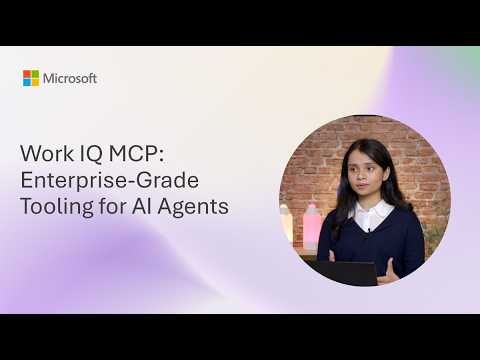
Work IQ MCP: AI Agents for Enterprise
Software Development Redmond, Washington
Work IQ MCP lets AI agents automate Outlook, Word, Teams and Dataverse with Microsoft governance and observability
Key insights
- Work IQ MCP provides enterprise-grade MCP servers that let AI agents securely access Microsoft 365 services (Outlook, Teams, Word, Dataverse) to automate real tasks.
It enforces governance and observability so agents run reliably in production. - Data Layer, Memory Layer, and Inference Layer form the core architecture: the Data Layer connects live systems and connectors, the Memory Layer preserves organizational context, and the Inference Layer reasons across signals to deliver actions and insights.
This layered design helps agents act with context and consistency. - Agents use audited, deterministic tools (for example, actions like createMessage, getEvents, createFolder) so tasks execute predictably and can be traced.
These tool endpoints include checks for latency, accuracy, and payload safety before they run in a tenant. - Enterprise-grade security and governance include scoped permissions, DLP and MIP policy enforcement, full auditing, rate limits, and runtime observability integrated into the Microsoft 365 admin experience.
Admins can enable, block, or monitor MCP servers centrally to keep agents within compliance boundaries. - Agent 365 acts as the control plane for identity, registry, access control, and interoperability, making it straightforward to scale agent deployments while keeping IT oversight.
It supports multi-tenant scenarios and helps ISVs and customers manage many servers without losing control. - Developer access and tooling include the Work IQ API (REST), a CLI, and SDKs for building MCP servers and agent skills, plus sample code for real integrations.
These tools let teams build secure, observable automations that improve accuracy and speed for common business workflows.
Overview of the Presentation
The YouTube demo, presented by Microsoft and shown during a Microsoft 365 & Power Platform community call on March 10, introduced a new approach to enterprise tooling for AI agents. The presenter explained how these servers let agents interact with services like Outlook, Word, Teams, and Dataverse while keeping security and governance intact. Importantly, the demo emphasized real work automation rather than toy examples, showing steps that organizations might adopt in production. As a result, viewers gained a clear sense of how this technology could fit into everyday business workflows.
Moreover, the session featured Fiza Musthafa as the primary demonstrator, and it focused on the operational side of agent deployment rather than purely research ideas. The team stressed that the offering is designed for IT and security teams as much as for developers, and so the talk balanced technical depth with governance concerns. Consequently, the presentation aimed to reassure enterprise audiences about control, audibility, and integration. Ultimately, the video framed the capability as a practical bridge from models to managed actions.
What the Demo Showed
During the demo, the speakers walked through how agents call deterministic tools to perform tasks such as creating messages, scheduling meetings, and retrieving documents. They highlighted that the system supports granular, auditable actions which administrators can trace and control, and that agents use scoped permissions rather than broad system access. In addition, the demo demonstrated cross-platform integration, showing agents drawing context from multiple services to complete a task end-to-end. Thus, the presentation underscored real-world scenarios where agents can reduce manual work while staying accountable.
Furthermore, the presenters showed command flows that included payload checks, rate limiting, and runtime observability, which together aim to prevent accidental or malicious operations. They also demonstrated how policy enforcement like data loss prevention and information protection can remain in place as agents act on behalf of users. This layering of safeguards suggests that administrators do not need to sacrifice compliance for automation. Therefore, the demo positioned the servers as a managed gateway where governance remains central.
Core Architecture and Capabilities
At a technical level, the solution centers on a three-layer model: data, memory, and inference, which together provide agents with context and reasoning abilities. The data layer connects to sources through APIs and connectors, giving agents live access to relevant content, while the memory layer preserves organizational context so agents can act with continuity. Meanwhile, the inference layer performs reasoning across signals to generate recommendations and actions that map to business needs. In short, the architecture aims to make agents context-aware and predictable rather than purely prompt-driven.
Developers can access these capabilities via a public CLI and a RESTful API that the presenters discussed, while enterprise teams manage deployments through a control plane that handles registry, identity, and access. The demo also referenced integration points with existing developer tools to simplify building and testing agent skills. Consequently, the setup supports both pro-code and low-code approaches, which helps organizations choose the best path for their teams. Overall, the architecture balances developer flexibility with centralized governance.
Enterprise Governance and Security
One of the central themes was governance: administrators can scope permissions, audit operations, and enable policy checks before agents act. The presenters emphasized that enterprise-grade features include tracing for audits, integration with identity systems, and the ability to activate or block agent servers centrally. Moreover, runtime observability and security scans help administrators enforce operational standards without manual intervention. Thus, governance is presented as a core capability rather than an afterthought.
However, implementing strict governance also introduces tradeoffs, because tighter controls can slow innovation and add configuration burden for teams that need rapid iteration. For example, payload validation and rate limits improve safety but can add latency and require more testing. Therefore, organizations will need to balance security needs against operational speed and user productivity. In practice, that balance will vary by industry, regulatory landscape, and risk tolerance.
Tradeoffs and Operational Challenges
Despite the clear benefits, the approach brings several challenges that organizations must weigh. First, integrating many data sources increases complexity and requires careful identity and permissions management, meaning teams should plan for a nontrivial setup effort. Second, making agents deterministic enough for production use requires robust testing and ongoing evaluation of both model outputs and connector behavior, which consumes resources and discipline. Consequently, teams should expect a learning curve and a period of tuning as they move from pilot to scale.
Moreover, the system raises questions about latency, model accuracy, and the cost of running always-available context services, especially when enterprises expect high reliability. While observability and rate limits mitigate some operational risks, they also create points where performance tradeoffs appear. Therefore, IT leaders must weigh expected productivity gains against infrastructure, monitoring, and governance costs. In the end, measured pilots with clear success criteria will help teams manage those tradeoffs.
Implications and Next Steps for Organizations
For organizations considering this approach, the demo suggests a staged strategy: pilot with narrow use cases that deliver clear value, then expand as governance and performance stabilize. In addition, collaboration between security, IT, and business teams will prove essential, because each group must agree on acceptable risk, observability needs, and operational standards. Training and change management will also matter, since users must trust agents to handle tasks on their behalf. As a result, successful adoption depends as much on people and process as on the underlying technology.
In conclusion, the YouTube demo from Microsoft painted a picture of practical, enterprise-ready tooling for AI agents that balances automation with governance. While the benefits include improved accuracy, auditable actions, and cross-platform integration, organizations should plan for integration complexity, governance overhead, and ongoing tuning. Ultimately, the demo frames the offering as a managed way to bring agents into production, and it invites IT leaders to test the approach in controlled pilots before wider rollouts.

Keywords
Work IQ MCP, enterprise-grade AI agent tooling, AI agent platform for enterprises, AI agent orchestration, scalable AI agent deployment, MLOps for AI agents, enterprise AI governance and compliance, secure AI agent management