- All of Microsoft
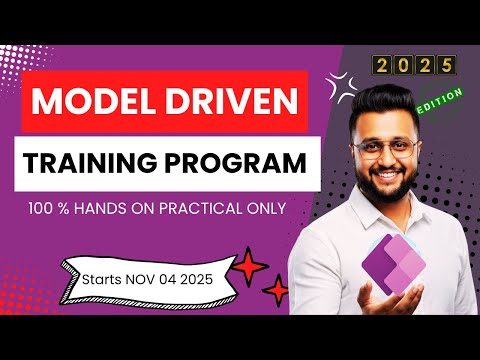
Model-Driven Apps: From Beginner to Pro
Microsoft MVP (Business Application & Data Platform) | Microsoft Certified Trainer (MCT) | Microsoft SharePoint & Power Platform Practice Lead | Power BI Specialist | Blogger | YouTuber | Trainer
Microsoft expert: Master Model-Driven Apps from beginner to advanced with Dataverse, Power Platform, JavaScript C# and AI
Key insights
- Model-Driven Apps and Dataverse: The video outlines building enterprise-grade apps by assembling forms, views, dashboards and business process flows on top of Dataverse.
It shows how data models drive the app layout and behavior for complex business scenarios. - JavaScript and C# Plugins: Hands-on modules cover client scripting with JavaScript plus server-side logic using C# plugins and workflows.
These sections teach when to use pro-code extensions versus low-code features. - AI-assisted development: The training highlights AI tools (code generation and assistant features) to speed up routine tasks and prototype components.
It explains practical ways to combine AI suggestions with standard development practices. - Hands-on project and recordings: Participants follow a real-world project that ties tables, forms, security and automation together, with recordings available for review.
This ensures learners can replicate the full build and deployment steps after the sessions. - Security & Deployment: The course covers role-based access, environment management and deployment pipelines for production-ready apps.
Learn how to configure security roles, manage environments, and deploy updates safely. - Format & prerequisites: The program uses interactive instructor-led sessions across weekday and weekend slots, totaling 35+ hours; it suits beginners through advanced users.
To follow along you need a Power Apps/Dataverse account (trial or tenant) and basic familiarity with app concepts helps.
Overview of the Video
The YouTube video by Dhruvin Shah [MVP] presents a live paid training program titled Master Model-Driven Apps from Scratch (Beginner to Advanced). The video outlines a structured, instructor-led course intended to teach participants how to build enterprise-grade model-driven applications using Power Apps and Dataverse. Furthermore, it emphasizes a blend of low-code and pro-code topics, together with emerging AI tools to accelerate development. In short, the video frames the course as a hands-on pathway from fundamentals to deployment.
Course Structure and Content
According to the video, the program spans multiple interactive sessions and more than 35 hours of content, covering topics from Dataverse basics to advanced plugin development. Participants are guided through practical modules such as tables and relationships, forms, views, dashboards, business process flows, and command bar customizations. In addition, the instructor introduces pro-code topics including JavaScript, C# plugins, workflows, and deployment practices, so learners can see how customization and automation fit into model-driven design. As a result, the course aims to present a full lifecycle of app development within the Power Platform ecosystem.
Integration of AI and Modern Tools
The video highlights how AI tools are woven into the training, showing ways to auto-generate code and accelerate routine tasks using assistants like Copilot and similar generative models. Consequently, learners are encouraged to pair traditional development skills with AI-driven productivity techniques, which can speed up code scaffolding and suggestion-driven debugging. However, the presenter also notes that AI outputs require careful review and tuning to fit specific business rules and security constraints. Therefore, students are taught to balance AI assistance with manual verification to maintain reliability and maintainability.
Practical Focus and Project Work
Importantly, the video stresses a project-based approach: attendees build a real-world application that integrates Dataverse and demonstrates end-to-end functionality. This hands-on emphasis helps learners see how forms, dashboards, business process flows, plugins, and deployment pipelines interact in practice. Moreover, the instructor includes live Q&A sessions and a project showcase to reinforce learning through feedback and peer examples. Consequently, participants can both practice skills and compare implementation patterns under instructor guidance.
Tradeoffs in Learning Paths
While the video promotes rapid upskilling through a concentrated live program, it also touches on tradeoffs that prospective learners should consider. For example, live training offers immediate interaction and tailored feedback, but it demands a fixed schedule and a steeper short-term time commitment compared with self-paced modules. Similarly, prioritizing pro-code features like plugins increases an app's flexibility and performance, yet it raises complexity, testing needs, and long-term maintenance overhead. Thus, the video encourages learners to weigh speed, depth, and maintainability when choosing what to master first.
Challenges and Practical Considerations
The video acknowledges several challenges that developers and organizations commonly face when adopting model-driven approaches. First, Dataverse and security roles can be conceptually dense, so misconfigurations may lead to access or performance issues if not handled carefully. Second, introducing custom plugins and JavaScript increases deployment complexity and the need for robust testing and version control. Finally, reliance on platform updates and third-party AI tools means teams must adapt to changing features and best practices over time. Consequently, the presenter stresses planning, governance, and ongoing learning as essential complements to technical skill.
Who Benefits and How to Begin
According to the video, the course suits absolute beginners who want structure as well as experienced developers seeking to formalize their enterprise app skills with Dataverse and pro-code techniques. Those who prefer instructor interaction and real-time feedback will likely gain the most, while independent learners might combine the training with free resources and hands-on practice. To get started, the presenter recommends having a Power Apps environment available and following introductory modules to familiarize oneself with the maker portal and common data models. Ultimately, the program is positioned as a practical route to applying model-driven design in business contexts.
Conclusion and Editorial Takeaway
In summary, Dhruvin Shah [MVP] delivers a clear and practical overview of his model-driven app training in the video, balancing course promotion with realistic notes on scope and challenges. The program's comprehensive scope—spanning Dataverse fundamentals, pro-code customization, deployment, and AI assistance—appears well suited for professionals aiming to deliver enterprise-grade solutions. Nevertheless, organizations and learners should consider schedule commitment, long-term maintenance, and governance when deciding whether a live cohort fits their needs. Overall, the video offers a useful roadmap for anyone looking to deepen their skills in model-driven applications on the Power Platform.

Keywords
model-driven apps training, Power Apps model-driven training, model-driven app course, Power Apps advanced training, model-driven apps for beginners, live paid Power Apps training, Dynamics 365 model-driven apps, model-driven app development course