- All of Microsoft
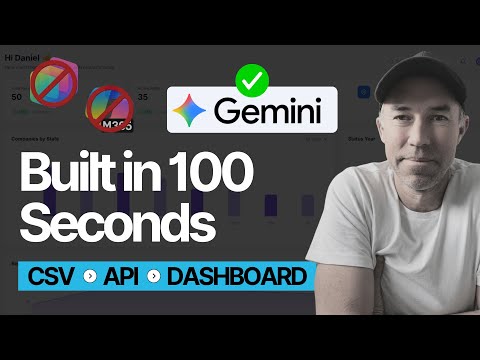
Gemini 3.0 Pro: No-Code Web App in 100s
A Microsoft MVP 𝗁𝖾𝗅𝗉𝗂𝗇𝗀 develop careers, scale and 𝗀𝗋𝗈𝗐 businesses 𝖻𝗒 𝖾𝗆𝗉𝗈𝗐𝖾𝗋𝗂𝗇𝗀 everyone 𝗍𝗈 𝖺𝖼𝗁𝗂𝖾𝗏𝖾 𝗆𝗈𝗋𝖾 𝗐𝗂𝗍𝗁 𝖬𝗂𝖼𝗋𝗈𝗌𝗈𝖿𝗍 𝟥𝟨𝟧
Microsoft expert: no-code Gemini Pro web app CSV upload API enrichment live dashboard with Copilot and Power Platform
Key insights
- Gemini 3.0 Pro — The video shows Google AI Studio using Gemini 3.0 Pro to build a full web app in about 100 seconds from plain prompts.
It demonstrates a fast, end-to-end prompt-to-production workflow without manual coding. - No-code development — The app’s UI and backend were generated by describing the desired outcome and supplying a reference image.
This lets non-developers and developers iterate on features by changing text prompts instead of writing code. - CSV upload & data enrichment — The demo includes a CSV upload that triggers automated lookups (ABN lookup in the example) and adds fields like state, postcode, incorporation date, and ABN status.
The system processed rows and produced an enriched dataset ready for review. - Live dashboard — The generated app shows a live dashboard with visualizations (state distribution pie chart, year-based bar graph) and a processed-results table.
The dashboard updates with enriched data so users can analyze trends quickly. - Prompt iteration — The presenter added a download-to-CSV button mid-build by updating the prompt and re-running the build, showing fast, interactive refinement.
This highlights how natural-language iteration enables rapid feature changes without redeployment. - Business impact — This approach lowers the barrier to prototype and deploy data-driven tools, speeding up workflows and decision-making for teams.
Enterprises can use it for fast experiments and to offload routine integration and UI tasks to AI while retaining control over deployment.
Quick Overview
Daniel Anderson [MVP] published a YouTube demonstration that shows a complete web application built in roughly 100 seconds using Gemini 3.0 Pro inside Google AI Studio. The video frames the exercise as a practical test of the emerging no-code paradigm, where natural language prompts replace manual programming. Consequently, the clip emphasizes speed, iteration, and the kinds of production-ready features an AI can assemble on demand. The result is a compact proof of concept that raises both excitement and questions about next steps for Teams.
The demo centers on a real-world scenario: uploading a CSV file and producing an enriched, downloadable dataset plus live charts. During the build, the presenter shows a prompt-driven workflow that adds API integrations, UI components, and styling from a reference image. This setup aims to illustrate how non-Developers might assemble data-driven interfaces quickly. At the same time, the clip invites viewers to consider whether rapid creation translates into lasting quality.
Demo Breakdown and Features
Throughout the video, Anderson walks viewers through discrete milestones, including the CSV upload widget, an ABN lookup integration, data enrichment, live dashboard visuals, and a CSV download. He also demonstrates on-the-fly iteration by requesting a download button mid-build and then re-running the generation to include it. These moments show how no-code prompts can steer an automated build pipeline in near real time. As a result, the demo feels less like a single magic trick and more like a guided conversation with a capable assistant.
Specifically, the app delivers state and postcode enrichment, ABN status and incorporation dates, a pie chart for state distribution, a year-based bar chart, and a processed results table. The presenter references a design mockup from Dribbble to influence styling and layout, demonstrating multimodal input. This combination of data plumbing, visual output, and minor design cues illustrates how varied inputs can shape a final product. However, the video also shows the importance of careful prompts to achieve consistent UI behavior.
Technology and Workflow Insights
Gemini 3.0 Pro in the demo acts as both a UI generator and backend orchestrator, translating plain-English instructions into frontend components and API calls. Google AI Studio provides the environment for composing prompts, previewing results, and iterating on changes. In this context, the tool chains reasoning, prompt templates, and prebuilt connectors to reduce friction between idea and prototype. Consequently, Teams can test concepts quickly without waiting for traditional Development cycles.
Multimodal inputs—text plus reference images—help guide the visual output, while agent orchestration coordinates data flow and enrichment steps. The demo highlights that the generated app can be previewed and tested immediately, including file uploads and data downloads. That said, the workflow presumes solid prompt design and an understanding of the desired data model. Therefore, success depends on both the platform’s capabilities and the user’s ability to communicate requirements precisely.
Tradeoffs and Practical Challenges
While rapid prototyping is a clear benefit, the tradeoffs include potential fragility in generated code and opacity in how logic is implemented. For example, automated integrations may work well for common APIs but require human review for edge cases, rate limits, and error handling. Moreover, design fidelity from a reference image may vary, leading to additional manual adjustments for accessibility, responsiveness, or brand compliance. Thus, speed can come at the cost of maintainability and predictability.
Another challenge is governance: organizations must decide how to vet AI-generated components for security, data privacy, and compliance. The demo uses an ABN lookup as an example, but production scenarios may involve sensitive data or complex business rules that need audits and tests. Furthermore, handoffs to engineering teams may still be required to harden generated artifacts for scale, observability, and long-term support. Consequently, teams should view these tools as accelerants rather than complete replacements for engineering rigor.
Business Implications
For product managers and business leaders, this demonstration highlights opportunities to compress development timelines for internal tools, prototypes, and marketing experiments. By enabling domain experts to assemble interfaces and workflows directly, companies can iterate on hypotheses faster and collect feedback earlier. At the same time, leaders must balance that agility with controls around quality and ownership, defining where AI-assisted creation fits into standard delivery pipelines.
Adoption decisions will hinge on factors such as team skills, compliance needs, and integration complexity. Organizations that pair prompt-driven development with clear testing and review processes can extract value quickly while mitigating risks. Conversely, teams that rely solely on rapid builds without governance may encounter surprise technical debt. Therefore, a hybrid approach that mixes AI speed with human oversight typically offers the best balance.
Takeaways and Next Steps
The video by Daniel Anderson [MVP] offers a concrete look at how no-code app building with Gemini 3.0 Pro can compress the path from idea to a working prototype. It makes a persuasive case for using AI assistants to lower the barrier to entry and accelerate iteration cycles. However, it also shows the practical limits that organizations must address, including maintainability, governance, and integration robustness. Thus, the technology is promising but not a turnkey substitute for disciplined engineering practices.
For teams curious to experiment, the sensible next step is to run controlled pilots focused on low-risk internal apps and to pair AI outputs with checks for data integrity and security. In addition, documenting prompt patterns and shared templates can improve repeatability across projects. Ultimately, this demo signals a shift in how organizations will work with AI: faster prototyping, broader participation, and new responsibilities for governance and quality assurance.

Keywords
Gemini 3.0 Pro web app, build web app in 100 seconds, no code web app builder, Gemini 3.0 Pro tutorial, rapid no-code app development, AI-powered web app builder, create web app without coding, instant web app creation