- All of Microsoft
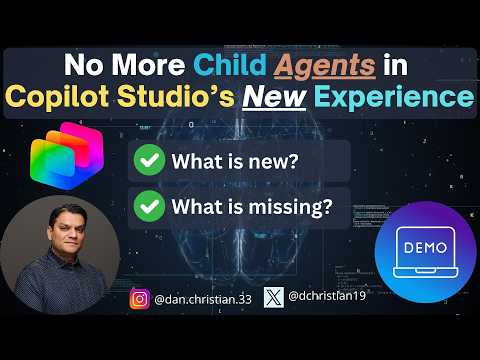
Copilot Studio Drops Child Agents
Lead Infrastructure Engineer / Vice President | Microsoft MCT & MVP | Speaker & Blogger
Copilot Studio drops child agents expert tips to migrate and leverage Microsoft Copilot Power Platform SharePoint AI
Key insights
-
Video overview: The video explains that the new Copilot Studio no longer offers Child Agents and replaces the old structure with a more unified Multi-Agent Orchestration approach.
It frames this as a strategic change to make agent interactions clearer, faster, and easier to maintain. -
Legacy model limits: The previous Parent-Child Model routed user requests from a master agent to subordinate child agents, which often caused extra latency and unclear answers.
Delegation added complexity and made testing and updates fragile. -
Key benefits of the new approach: Treating agents as connected peers improves Accuracy, reduces latency for faster Performance, and increases overall Reliability when you update or test individual agents.
The orchestration runtime now invokes specialized agents dynamically, reducing translation errors from intermediary routing. -
Developer impact: Teams should stop planning around nested child agents and instead design agents as independent, callable components for easier Migration and safer Testing.
Expect to adjust routing logic and adapt any automation that assumed a strict parent-child relationship. -
Immediate actions: Inventory existing child agents, document each agent’s responsibilities, and map how those functions become standalone peers in the new model (Inventory and Documentation).
Build and test small, independent agents first to verify orchestration and response quality. -
Long-term strategy: Design agents as Interoperable Agents that share context via explicit Context Sharing patterns and monitoring hooks.
Monitor response quality and latency, keep domain logic modular, and plan incremental rollouts to reduce disruption.
Introduction
In a recent YouTube video, Daniel Christian [MVP] explains that the updated Copilot Studio no longer supports the creation of child agents. He frames this change as a deliberate architectural shift rather than a simple feature removal, and he walks viewers through what it means for developers and enterprises. Consequently, the video highlights both immediate impacts and longer-term implications for agent design and orchestration.
Moreover, the presentation balances practical advice with broader context so teams can plan migration and testing work. The video also reviews the legacy behavior of child agents and compares it to the new multi-agent approach. As a result, the message is that teams must rethink how they build composable AI solutions in Copilot Studio.
What Changed: From Child Agents to Peer Orchestration
Historically, the platform used a hierarchical model in which a parent agent delegated tasks to subordinate child agents that specialized in narrow domains. In contrast, the updated model treats specialized capabilities as connected peers in a single orchestration layer, which reduces rigid parent-child handoffs. Daniel Christian describes this as moving from silent subordinates to interoperable collaborators, and he emphasizes that the system will now invoke agents dynamically based on intent and context rather than fixed attachments.
Consequently, the new approach aims to remove extra routing steps that once introduced latency or ambiguity. The video underscores how this change can produce sharper, more cohesive replies because the runtime integrates domain knowledge directly rather than relying on the parent to re-interpret child outputs. Thus, the experience should feel more consistent for end users while offering clearer points for governance and testing.
Key Benefits and Practical Gains
First, Daniel Christian highlights improved answer quality as a primary benefit; the system can combine specialized knowledge without the parent agent misreading a child's response. Next, he points out that performance should improve because the orchestration avoids the back-and-forth handoff that once added delays. Together, these factors can increase responsiveness in enterprise scenarios where speed and accuracy matter most.
Additionally, the presenter argues that maintainability and safer updates are strong wins under the new model. Teams can change or replace individual agents without risking a hidden dependency inside a parent agent’s routing logic, and testing becomes more straightforward because each connected agent is easier to validate in isolation. Consequently, organizations can iterate faster while reducing the chance of accidental breakage during updates.
Tradeoffs and Migration Challenges
However, the change brings tradeoffs that Daniel Christian carefully outlines. For example, while the peer model reduces some complexity, it also requires teams to redesign how they preserve conversation state and share context across agents, which can be nontrivial for workflows that depended on implicit parent-managed context. Thus, migration will likely involve rethinking state management, handoff rules, and how tools integrate with agent logic.
Furthermore, some legacy use cases relied on the explicit separation that child agents offered, such as strict domain boundaries or specialized security rules enforced within a child agent. Replacing those guarantees requires careful planning around access control, permissions, and testing. As a result, teams must weigh the operational benefits of the new architecture against the upfront effort to adapt existing solutions.
How Teams Should Move Forward
Daniel Christian recommends several practical steps to ease the transition and reduce risk. First, assess which child agents perform unique stateful workflows and document how they pass context today, because this mapping guides the redesign. Then, prototype a few critical flows using the connected peer model to validate performance, context propagation, and security controls before migrating larger suites of agents.
Finally, he suggests leveraging modular testing and staged rollouts to catch issues early while maintaining service continuity. By prioritizing high-value, low-risk migrations, teams can demonstrate quick wins and build confidence in the new pattern. In the long run, the new model can lead to faster iteration and clearer governance, provided teams invest the time to redesign context and security boundaries correctly.
Conclusion
The video from Daniel Christian [MVP] frames the removal of child agents in Copilot Studio as a strategic evolution toward a unified multi-agent orchestration approach. While the update promises better performance, clearer answers, and safer updates, it also forces teams to confront migration work, context modeling, and governance changes. Therefore, organizations should approach the transition with targeted testing, careful documentation, and staged rollouts to balance short-term disruption against long-term gains.
Overall, the shift represents a notable change in how Microsoft intends to scale composable AI experiences, and the video provides a clear, practical roadmap for teams preparing to adapt. As a result, stakeholders should treat this as an opportunity to modernize designs and improve reliability, while acknowledging the upfront costs of migration and redesign.

Keywords
Copilot Studio update, No more child agents Copilot Studio, Child agents removed Copilot, Microsoft Copilot Studio changes, Copilot Studio agent architecture, Copilot Studio 2026 update, Migrate from child agents Copilot, Copilot Studio new agent model