- All of Microsoft
Copilot Studio: Build Agents with Tools
Software Development Redmond, Washington
Build dynamic Copilot Studio agents with tools, instructions and Dataverse for governable enterprise Copilot
Key insights
- Copilot Studio: a SaaS platform that turns natural-language intent into executable agent logic using a low-code authoring canvas.
It lets non‑developers build and refine agent workflows with visual tools and conversational inputs. - Copilot Agents: intelligent process entities that combine instructions, tools, and enterprise knowledge to perform tasks.
Design agents as modular units or child agents (for example, account lookup or procurement) so they can delegate and coordinate work. - Power Automate connectors: connectors expose flows and actions that agents can call to run real-world business processes.
They connect to Microsoft 365 sources, third-party services, and custom MCP servers so agents can act on live data and systems. - Tools and Instructions: clear tool descriptions and concise instructions help the orchestrator choose the right tool without large, complex prompts.
Pairing good descriptions with structured instructions improves reliability, governance, and predictable behavior. - Multi-Agent Orchestration: let agents delegate to specialized agents for tasks like billing, troubleshooting, or approvals to scale automation across the enterprise.
This approach improves maintainability, supports conditional logic and escalation, and enables complex, multi-step processes. - Dataverse and Computer Use: Dataverse-backed data powers dynamic, conversational task execution and state management for enterprise scenarios.
Planned "computer use" features will let agents interact with web and desktop apps (including legacy systems) and run actions using personalized triggers for richer automation.
Context and source
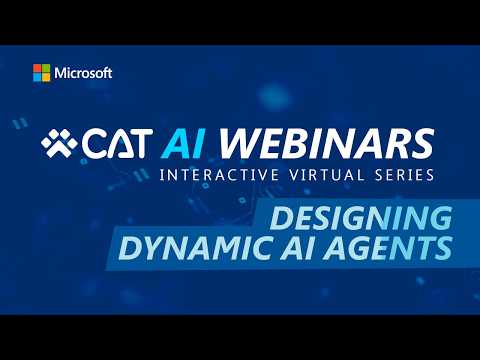
The YouTube video, published by Microsoft, documents a session from the CAT AI Webinar series titled “Leveraging Instructions and Tools to Build Dynamic Agents.” In the video, Microsoft experts walk through how to use instructions, tool descriptions, and generative orchestration inside Microsoft Copilot Studio to create agents that act on real business tasks. The session targets makers and technical leads who want to improve agent decision-making and deployment readiness for enterprise scenarios.
Importantly, the webinar highlights practical examples such as account lookup and procurement workflows to show real-world agent behavior. Consequently, viewers can see both high-level patterns and specific authoring techniques that improve performance and maintainability. The recording is framed as an instructional demo rather than an academic deep dive, so it favors applied guidance and step-by-step illustration.
Building agents in Copilot Studio
The presenters emphasize a modular approach using child agents, connected tools, and Dataverse-backed data to enable dynamic, conversational task execution. Makers compose agents from natural language instructions and defined tools, which together allow the orchestrator to pick the right action without heavy instruction sets. This lowers the barrier for business users to describe intent while preserving structured automation under the hood.
Moreover, the demo shows how well-written descriptions guide tool selection and reduce brittle behavior that comes from overly large, complex prompts. As a result, agents can remain both flexible and predictable, which is crucial for enterprise governance. The presenters also point out that clear descriptions make debugging and iterative improvement far easier for teams.
Core capabilities and integrations
The platform connects agents to existing process automation through Power Automate connectors and other enterprise data sources such as Dataverse and Microsoft 365. Therefore, agents can run flows, access messages or calendars, and call external services, which turns conversational commands into concrete business actions. This integration model preserves investments in current systems while enabling conversational orchestration.
Additionally, the authors highlight a low-code authoring canvas where creators define topics, multi-turn dialog flows, and conditional logic. Consequently, teams can model complex sequences and escalation paths without deep coding expertise. This balance between visual design and programmable detail supports both citizen makers and professional developers.
Recent enhancements showcased
The webinar highlights two major advancements that shape future agent capabilities. First, the expansion of multi-agent orchestration enables agents to delegate work to specialized child agents, so a single request can trigger coordinated actions across functional agents. This design supports scale and specialization, for example separating billing, technical support, and procurement responsibilities among dedicated agents.
Second, the video previews emerging support for browser and desktop automation termed computer use, which allows agents to interact directly with legacy interfaces when APIs are unavailable. While this extends reach, the presenters stress that it introduces new security and reliability considerations, especially around credential management and UI fragility. They note that triggers using end-user credentials will become available to improve personalized context while requiring careful governance.
Balancing tradeoffs and practical challenges
The session candidly discusses tradeoffs between flexibility and control when designing agent behavior. On one hand, natural language descriptions make agent creation accessible and adaptive; on the other hand, over-reliance on loose descriptions can produce unpredictable outcomes, so authors must craft precise tool descriptions and constraints. Therefore, organizations should combine descriptive guidance with structured tool interfaces to maintain reliability and auditability.
Governance and maintainability also present practical challenges as agent landscapes grow. Multi-agent setups reduce complexity by splitting responsibilities, yet they require robust monitoring, versioning, and testing strategies to avoid cascading failures. Consequently, teams must invest in observability, clear ownership, and staged deployment to scale safely in production environments.
Implications for adopters and next steps
For organizations evaluating agent adoption, the webinar offers actionable advice: start small with clear use cases, emphasize tool descriptions and governance, and iterate using measurable outcomes. By contrast, moving too quickly to broad automation can amplify risk, so the presenters recommend phased pilots and close collaboration between business owners and platform teams. These steps help balance speed with enterprise readiness.
In summary, the YouTube video from Microsoft presents a practical roadmap for building dynamic agents in Microsoft Copilot Studio. It combines demonstration, design guidance, and candid discussion of tradeoffs, making it a useful resource for teams planning agent-driven automation at scale.
Keywords
Microsoft Copilot Studio tutorial, dynamic agents Copilot, build AI agents Copilot Studio, Copilot tools and instructions, prompt engineering for Copilot agents, custom Copilot agents guide, automated agent workflows Copilot, interactive AI agents Microsoft